
Phone Case Private Label Guide: OEM vs. ODM Tooling, Branding Processes, Packaging SKU Control and Sample QC
Bottom line: A B2B phone case private label program succeeds when the buyer locks the device matrix, OEM or ODM tooling route, TPU/PC or liquid silicone material specification, UV printing or IMD branding process, retail packaging SKU rules, and golden sample acceptance gates before mass production. Retail print-on-demand portals and promotional merchandise catalogs serve single-unit gifts or corporate handouts, whereas factory-direct private labeling requires controlled resin datasheets, physical color swatches, documented MOQ and lead time checkpoints, and pre-shipment inspection records. Treat all external supplier numbers below as market reference examples and verification hypotheses, not CHAMPIONS test results or commercial guarantees.
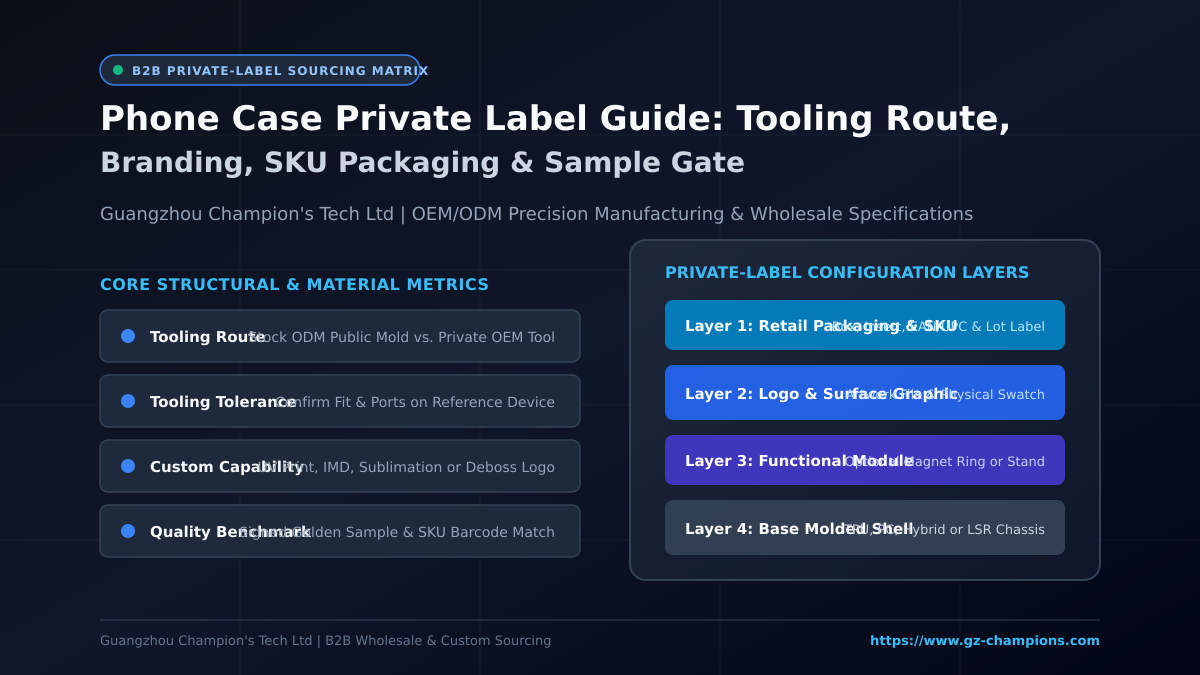
This guide helps brand owners, distributors, and product managers compare consumer print-on-demand, promotional bulk catalogs, and factory-direct OEM/ODM private-label manufacturing using live DataForSEO SERP evidence and external supplier references.
1. Separate Retail Print-on-Demand, Promotional Bulk, and Factory OEM/ODM Private Label
When procurement teams search for private label phone cases, search engine results frequently blend three distinct business models. Selecting the wrong supply tier early creates unit-cost surprises, limited model coverage, or inconsistent packaging barcodes across replenishment lots.
- Consumer Print-on-Demand (POD) Portals: Retail platforms such as caseable and Walgreens Photo serve single-unit photo gifts on pre-stocked blanks (for example, retail cases around $29.99), leaving wholesale buyers without resin, cavity, or custom packaging control.
- Promotional Merchandise Aggregators: Promotional catalogs such as iPromo imprint company logos onto event giveaways and card sleeves, which fits marketing handouts rather than multi-model retail SKU programs.
- Factory-Direct OEM/ODM Private Label: Direct OEM/ODM factories let brands lock either a public ODM mold or a private OEM tool while controlling the bill of materials, finish, magnetic array, and retail barcode hierarchy.
| Sourcing Dimension | Retail Print-on-Demand (POD) | Promotional Bulk Catalog | Factory-Direct ODM Private Label | Factory-Direct OEM Private Mold |
|---|---|---|---|---|
| Primary Use Case | Creator merch, single-unit photo gifts, zero-inventory testing | Corporate giveaways, event kits, branded card sleeves | Fast multi-SKU retail or e-commerce brand launch | Proprietary industrial design, custom grip or camera armor |
| Tooling Ownership | None (platform-selected stock blank) | None (distributor stock item) | Factory-owned public mold; buyer owns artwork and packaging | Buyer-contracted cavity/insert or exclusive mold agreement |
| Material & Color Control | Fixed catalog blanks only | Standard stock colors with surface imprint | Custom Pantone resin dosing or surface coating on stock chassis | Full resin grade, Shore hardness, co-molding and texture control |
| Decoration Scope | Surface digital print or sublimation transfer | Pad print, screen print, or laser mark in fixed logo zone | UV print, IMD/IML film, debossing, electroplating, woven inlay | Custom 3D relief, multi-shot overmold, custom metal bezel/buttons |
| Packaging & Traceability | Generic mailer or platform sleeve | Bulk polybag or simple gift box | Custom dieline retail box, EAN/UPC/FNSKU label, lot code | Custom structural packaging, molded pulp/EVA tray, full lot trace |
2. Lock the Device Matrix and ODM vs. OEM Tooling Route
Most retail launches span multiple iPhone, Samsung Galaxy, and regional handset models. Because each handset generation changes camera geometry, button cutouts, and corner radii, every model requires a dedicated mold cavity or insert.
When to Use Public ODM Tooling
When differentiation comes from graphic collections, seasonal colorways, or retail packaging, existing ODM public molds avoid steel-cutting expense. Verify single-shell vs. hybrid construction, camera lip clearance, and button tactility on current handset revisions.
When to Commission a Private OEM Mold
Proprietary corner geometry, integrated kickstands, or custom exterior ribs require a dedicated OEM tool or custom insert. Review our private mold phone case manufacturer guide to lock draft angles, parting lines, gates, and cavity count before tooling.
3. Material Selection and Cross-Substrate Color Control
Private-label buyers frequently specify a single brand color palette across multiple case constructionssuch as a flexible TPU grip case, a rigid polycarbonate (PC) snap case, a hybrid TPU/PC magnetic shell, or a liquid silicone (LSR) soft-touch series. As external manufacturing reference THGE Phone Case’s color and material guide notes, common private-label substrates include TPU, PC, silicone, leather, eco-friendly bioplastics, and carbon or aramid fiber composites, and identical Pantone codes can appear visibly different across TPU, PC, and silicone due to differences in base resin translucency, surface gloss, and curing chemistry.
Managing Color Consistency Across Materials
Do not approve a multi-material collection from screen renders alone. Require physical color chips molded or coated on the exact target substrate (TPU, PC, or LSR) and review them under D65 lighting against a signed control swatch.
Magnetic Ring and Functional Insert Integration
For magnetic wireless charging SKUs, specify how the magnet array is recessed, overmolded, or sealed beneath a microfiber liner so repeated attachment does not lift the cover.
4. Logo Branding and Surface Decoration Engineering
The decoration method determines both shelf appeal and long-term abrasion resistance. Different artwork stylesminimalist monochrome wordmarks, photographic seasonal prints, or metallic emblemsrequire distinct factory equipment and adhesion checks.
- In-Mold Decoration (IMD / IML): Graphic artwork is printed onto a PET or PC film and thermoformed inside the injection mold before resin injection, sealing the ink layer beneath a protective outer surface. For high-volume graphic collections where scratch resistance is critical, see our IMD phone case manufacturer guide.
- UV Digital Printing and Varnish Overcoat: Ideal for lower-minimum multi-SKU artwork runs or textured relief patterns on flat PC or hybrid backs. Because UV ink sits on the exterior surface, buyers should specify surface primer preparation and an agreed cross-hatch tape adhesion or alcohol-rub check during sample sign-off.
- Heat-Transfer Sublimation: As external industry reference Aikusu’s custom logo sublimation manufacturing analysis explains, heat sublimation transfers dye into a polymer coating or metal/PC insert at elevated temperature (unlike surface-only UV curing), and requires vector logo files (AI, EPS, SVG, or high-resolution PDF/PNG) paired with ICC color profile management to keep brand colors stable across batches.
- Debossing, Laser Engraving, and Metal Badges: On liquid silicone, PU/genuine leather wrap, or matte PC shells, mold-cavity debossing, precision laser etching, or recessed zinc-alloy/aluminum logo plates provide a permanent tactile brand signature without ink wear risks.
5. Commercial Structure, Sample Lead-Time Hypotheses, and SKU Packaging Control
Minimum order quantities (MOQs) and sampling windows in private-label manufacturing depend on whether the factory is pulling stock resin colors on an active public mold or compounding custom pigment batches with custom-printed retail boxes. External supplier publications illustrate how commercial tiers typically scale across the industry (cited strictly as external supplier examples, not CHAMPIONS commercial commitments):
- Sampling and Mass-Production Windows (External Example): In its public customization guide, THGE Phone Case reports typical reference windows of 35 days for standard samples, 510 days for custom color or material samples, 300500 pieces per model/color for standard customization, 5001,000 pieces for custom Pantone resin or packaging runs, and 1225 days for mass production after sample approval.
- Sublimation and Logo Trial Tiers (External Example): For heat-transfer and blank/logo programs, Aikusu’s supplier comparison cites reference trial thresholds starting around 50 pieces for custom logo orders, 100 pieces per model for blank stock cases, and 300 pieces for custom mold development.
Always require written MOQ breakdowns per handset model, color, and packaging dieline before ordering, and consult our phone case packaging guide for retail box and barcode control.
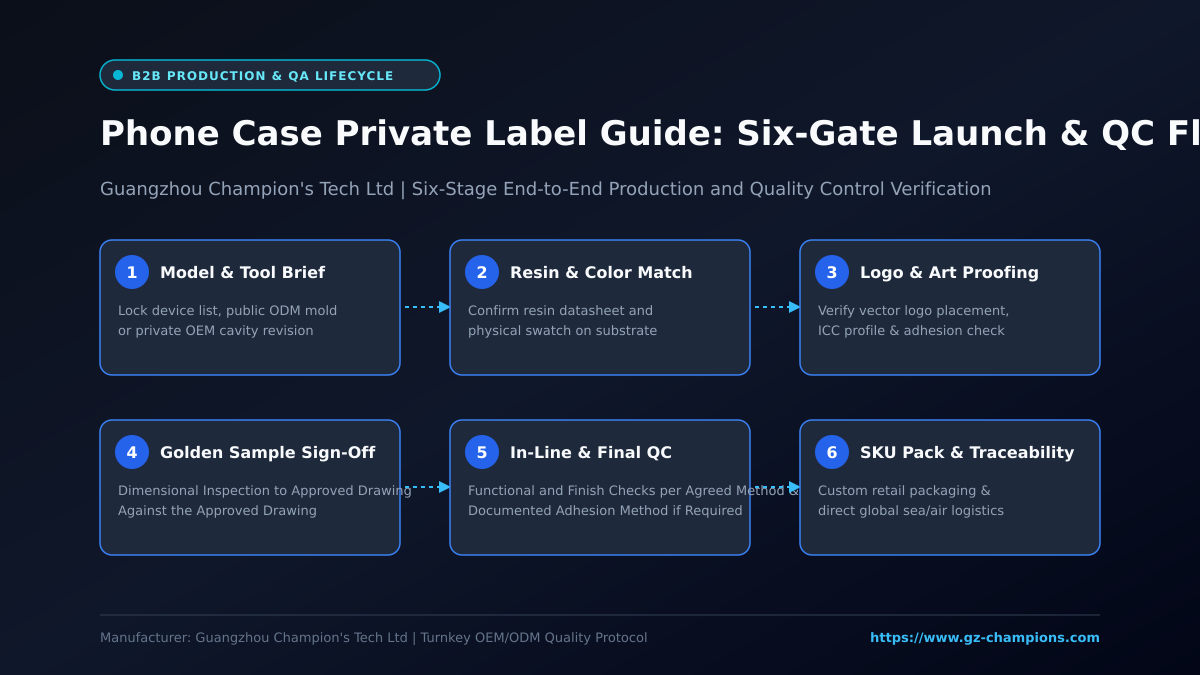
6. Pre-Shipment Quality Gates and Golden Sample Verification Matrix
Never rely on verbal assurances or unverified labels for drop ratings, compliance, or tolerances; lock a signed golden sample and inspect each lot against the matrix below.
| Verification Gate | Inspection Target | Buyer Acceptance Evidence Required |
|---|---|---|
| 1. Dimensional & Handset Fit | Corner snap retention, camera bezel clearance, port cutouts, button click feel | Fit check record on physical handset or verified gauge fixture for every model SKU |
| 2. Substrate & Color Identity | Resin family (TPU/PC/LSR), Shore hardness target, Pantone or swatch match | Resin supplier datasheet, incoming lot record, and signed physical color limit sample |
| 3. Logo & Graphic Durability | Registration alignment, color density, surface scratch and rub resistance | Approved artwork proof, ICC profile note, and agreed tape/alcohol rub inspection log |
| 4. Functional Module Check | Magnetic array pull/alignment, wireless charging pass-through, stand hinge life | Functional test sheet with specified charger/accessory set and pass/fail criteria |
| 5. Retail Packaging & Barcodes | Retail box dieline, inner tray fit, EAN/UPC/FNSKU scan grade, master carton marks | Live barcode scanner verification photo, packing list, and PO lot traceability label |
| 6. Compliance Documentation | Market-required material declarations (e.g., RoHS, REACH, Prop 65 if applicable) | Current third-party lab report or resin declaration tied to the exact bill of materials |
7. Seven-Point RFQ Checklist for Private-Label Buyers
- Exact Handset Matrix: List every target phone model, regional variant, and screen size so the factory confirms public ODM mold availability vs. new tooling requirements.
- Chassis Construction & Resin Grade: Specify single-material TPU/PC/LSR or multi-layer hybrid construction and request the corresponding resin datasheet.
- Logo & Artwork Package: Provide vector files (AI/EPS/PDF), exact logo dimensions, placement coordinates, and Pantone or physical swatch references.
- Functional Accessories: State whether magnetic rings, camera control buttons, lanyard loops, or microfiber linings are required and how they are anchored.
- Retail Packaging Specification: Attach box dielines, insert material preferences, barcode symbology (EAN/UPC/FNSKU), and master carton weight/dimension limits.
- Sample & Change-Control Protocol: Define how golden samples are labeled, how many reference units are retained by each party, and written notice rules before any resin or mold change.
- Inspection & Acceptance Criteria: Agree on pre-shipment sampling plans, cosmetic defect limits (flash, flow lines, sink marks, dust), and functional check methods before mass production begins.
Source & methodology note: Target keyword metrics and SERP candidates were audited via DataForSEO (`phone case private label`, US English: search volume 10, CPC USD 2.54, keyword difficulty 48, competition HIGH; raw SERP cached in `output/2026-11-03-phone-case-private-label-guide-serp.json`). Organic SERP references include caseable, iPromo, and Walgreens Photo. Because those consumer and promotional pages do not publish factory OEM engineering breakdowns, two B2B manufacturing references were retrieved via AnySearch fallback and explicitly labeled as external supplier examples: THGE Phone Case color and material guide and Aikusu custom logo manufacturing guide.
Scope Your Private-Label Phone Case Program
When your device list, construction preference, logo artwork, and packaging brief are ready for technical review, you can compare our OEM/ODM manufacturing overview, explore structural capabilities in the OEM Center, or submit your project files through the custom phone case inquiry page. CHAMPIONS reviews each RFQ against your exact handset matrix and sample verification requirements without assuming unverified MOQ, capacity, certification, or lead-time claims.
Ready to Build Your Custom Phone Case Line?
Send your product type, target model, material, packaging request and estimated quantity. The CHAMPIONS team will review the project details and reply with the next steps.