
Phone Case Packaging Sourcing Guide for OEM Buyers
For an OEM phone case program, packaging should fit the finished case and its included accessories, protect the surface through the selected route to market, and be practical to print, assemble and replenish. Define the retail or e-commerce channel and shipping path first; then approve structure, artwork, samples and a route-specific test plan with the packaging supplier. A screen proof alone is not production approval.
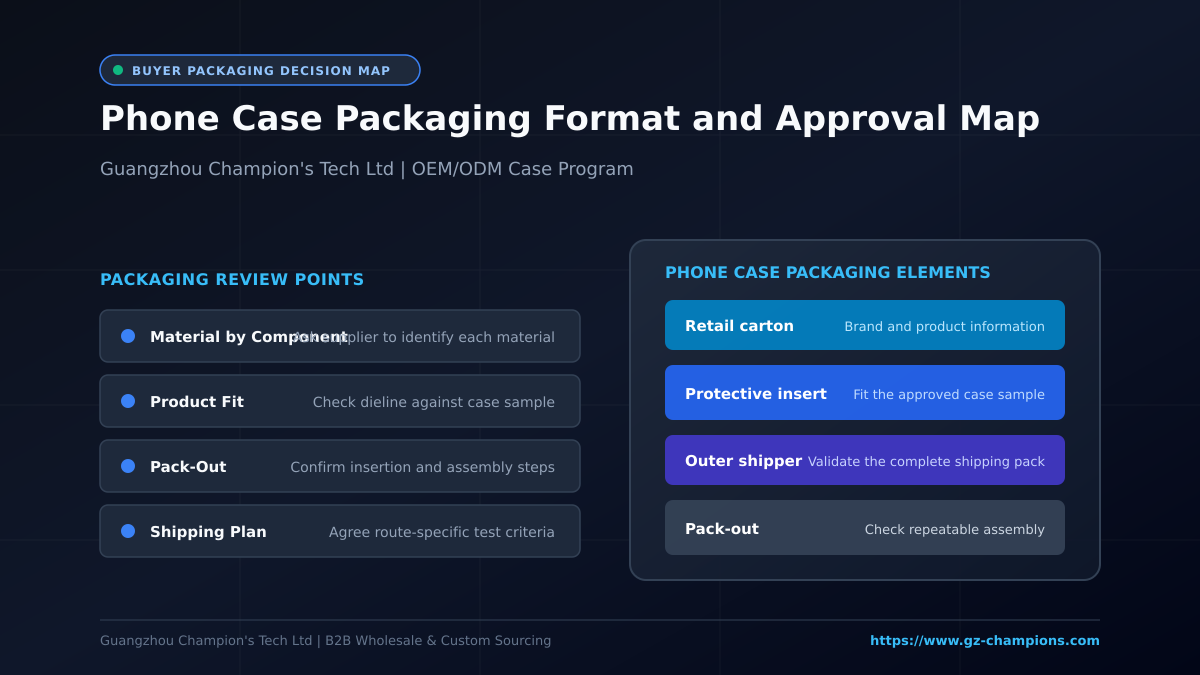
Start with the packaged product and sales channel
Before requesting a quote, define the exact product configuration. A slim TPU shell, a hybrid case with a raised camera frame, a magnetic case and a retail bundle with a cable or screen protector do not occupy the same envelope. Send the packaging supplier the approved finished product and every included component, not just a phone model name or an unassembled CAD outline. Ask the supplier to confirm what dimensions and clearances it used in the dieline.
Next, describe where the package will be handled: peg display, shelf, distributor carton, marketplace fulfillment or direct parcel delivery. A package designed to hang in a store may need a display feature and a retail-ready label panel; an e-commerce order may need an outer shipper that is tested as part of the parcel configuration. These are different jobs. Do not assume a retail box alone is designed to withstand a parcel network.
Put the brief in writing. Include the product SKU and device family, color/material variants, accessories, target channel, packed and master-carton configuration, destination markets, brand artwork status, barcode and language requirements, and the target cost or launch volume if known. Identify which decisions are still open. This helps a packaging manufacturer quote a defined scope instead of guessing at unseen requirements.
Compare packaging structures by use case
| Format | Where it can fit | Questions to resolve before approval |
|---|---|---|
| Folding paperboard carton | Compact retail presentation with printable panels and a shaped insert or card | Does the insert retain the case without rubbing it? Can the pack be assembled consistently? Does the chosen board and finish meet the display and handling needs? |
| Rigid setup box | Gift-oriented or premium presentation where a firm box is part of the experience | Is the added material and shipping cube justified for the channel? How are the lid, tray and product secured? Can the packed set fit the master carton efficiently? |
| Clear plastic blister or clamshell | When product visibility or a formed cavity is a priority | Does the cavity match the case geometry and finish? How is it sealed and opened? What exact polymer is used, and what disposal or recycling guidance is appropriate in each destination? |
| Corrugated mailer or shipper | Outer protection for parcel, replenishment or multi-unit transport configurations | Is it an outer shipper or the retail pack itself? What product-plus-package configuration will be tested? How are voids, movement and corner exposure controlled? |
| Paperboard or molded-fiber insert | Separating a case from accessories, printed matter or other items in a bundle | Does the insert prevent movement without creating pressure marks? Can operators place it quickly? Does it remain secure after the package is closed? |
These are selection prompts, not performance guarantees. The right format depends on the physical sample, the buyer’s presentation goals, pack-out method and distribution route. Ask suppliers to quote comparable configurations so a price comparison does not hide differences in material, insert, print coverage or shipper packaging.
Lock the structure before final artwork
Structural and graphic design should be developed together. Hood Container’s packaging development overview describes a sequence that connects the brief, structural design, graphics, prototypes, manufacturing and logistics; it also notes that a dieline must account for how the package folds, glues, stacks and fits its shipper. For a phone case, use the actual approved sample to check camera-lip clearance, side-button shape, magnetic ring or accessory placement, and whether a soft-touch or coated surface can be scuffed by an insert.
Request a dimensioned dieline with revision control. Confirm the internal fit, closure, hang feature if needed, glue areas, print-safe zones, barcode panel, product identification and packed master-carton dimensions. The supplier should identify its own production tolerances and the inspection method; do not copy a generic tolerance into the specification without confirming that it is meaningful for the chosen board, die-cut and pack format.
Artwork approval is a separate gate. Review spelling, model compatibility, brand hierarchy, barcode readability, color references, finish callouts and all market-facing product or environmental claims. The buyer should provide or approve legal text for each destination market. A printer proof can show layout and color intent, but it does not prove product fit, closure strength, pack-out speed or transit protection.
Use staged samples instead of one screen approval
Ask for samples that answer different questions:
- Structural white sample: confirm the physical dimensions, product fit, insert retention, closure and assembly sequence using the finished phone case and included accessories.
- Printed mock-up: review panel hierarchy, color and finish on the real structure. Check both the assembled package and the flat artwork; a design that looks balanced on a monitor may crowd a narrow side panel.
- Production-intent sample: approve the final specified material, print method, finish and pack-out before the first larger run. Record the sample revision and retain an approved reference where the buyer and supplier can identify it.
Hood’s overview describes white structural samples, printed mock-ups and pre-production samples as distinct stages, and recommends testing and incorporating feedback before the production run. Treat any supplier-specific schedule, sample fee or minimum order as a quote item to confirm; none is assumed in this guide.
Choose a distribution test for the real shipping path
For shipping validation, define the whole test article: phone case, retail packaging, any inner protection, outer shipper, pack count and the prepared shipping configuration. Agree on the route and acceptance criteria before samples are tested. Photograph the package and product before and after, record the test sequence and inspect the product, insert, closure and printed surfaces for the failure modes that matter to the buyer.
ISTA distinguishes non-simulation 1-Series integrity tests, 2-Series partial-simulation tests and 3-Series general-simulation tests. Its procedure directory says 1-Series is useful for screening but is not designed to simulate environmental occurrences; 2-Series is not intended to predict shipping performance; and 3-Series simulates damage-producing motions, forces, conditions and sequences for defined distribution contexts. Select a procedure with the testing lab based on the shipment, not because a protocol name appears on a supplier quote. A test report applies to the tested configuration and conditions; it does not automatically certify every product or shipping route.
For a phone case, include appearance and fit checks alongside package integrity. A carton can arrive intact while an insert has polished the case surface, a printed panel has rubbed, or a bundle component has shifted. Conversely, a visually marked outer package may still have protected the product. The buyer and supplier should agree in advance how each condition is classified and documented.
Make material and environmental claims traceable
For paper and packaging, FSC explains that manufacturers using FSC-certified or controlled forest-based materials can pursue chain-of-custody certification, which verifies processes for producing and trading certified products; eligibility to use FSC trademarks depends on the applicable certification or licence. Therefore, do not print an FSC mark or claim simply because a paper supplier says its stock is “eco” or “responsibly sourced.” Request current documentation for the specific material and product, and confirm who is authorized to make the on-pack claim.
For plastic formats, ask the supplier to identify the resin and any recycled-content claim by component. Avoid a broad “recyclable” statement unless the buyer has checked the exact material, local collection infrastructure and labeling rules for the markets where the package will be sold. Keep the pack specification, supplier declarations, artwork approval and claim evidence together so a later material substitution triggers review rather than silently changing the claim.
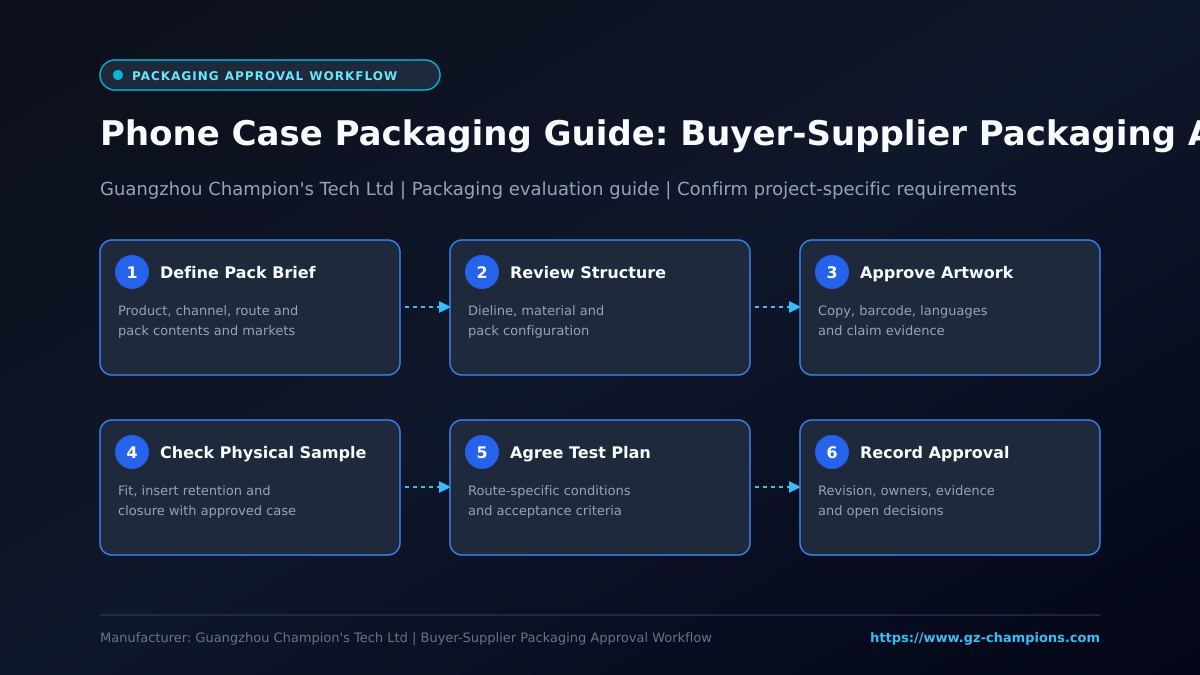
Packaging RFQ and quality checklist
- Product sample, device family, surface finish, accessories and final packed contents are identified.
- Sales channel, destination market, display method and shipping route are stated.
- Supplier quote identifies structure, material by component, insert, closure, print and finish assumptions.
- Dimensioned dieline is revision-controlled and checked with a finished product sample.
- Artwork, barcode, language and any environmental or product claims have named approvers.
- White sample, printed proof and production-intent approval are separate recorded gates.
- Pack-out and master-carton arrangement are reviewed for fit, assembly and handling.
- Any drop, vibration, compression or other distribution test is selected for the defined route and configuration; the report records the actual conditions and acceptance criteria.
- Substitutions, inspection records, defect handling and reference-sample retention are agreed in the purchase specification.
Build the package brief with your case program
Packaging works best when it is scoped alongside the case rather than after the product specification is frozen. CHAMPIONS buyers can review the company’s OEM/ODM program, custom case options, and current product range while preparing a brief. Product models, materials, packaging scope and commercial terms still need confirmation for each project.
Send the case sample or specification, intended sales channel, destination markets, packaging format preference and artwork status through the inquiry page. The team can then clarify what information is needed to scope a packaging discussion; this guide does not promise a particular material certification, test result, MOQ or lead time.
Sources and scope
Packaging development sequence and sample types: Hood Container, Retail Packaging Design Process. Test family descriptions: International Safe Transit Association, Test Procedures. Paper packaging chain-of-custody and trademark context: Forest Stewardship Council, Paper & Packaging. External materials are general supplier/organization references, not CHAMPIONS internal test evidence.
Ready to Build Your Custom Phone Case Line?
Send your product type, target model, material, packaging request and estimated quantity. The CHAMPIONS team will review the project details and reply with the next steps.