
{
“@context”: “https://schema.org”,
“@graph”: [
{
“@type”: “Organization”,
“@id”: “https://www.gz-champions.com/#organization”,
“name”: “Guangzhou Champion’s Tech Ltd”,
“url”: “https://www.gz-champions.com/”,
“logo”: “https://www.gz-champions.com/wp-content/uploads/logo.png”,
“contactPoint”: {
“@type”: “ContactPoint”,
“contactType”: “sales”,
“email”: “karl@gz-champions.com”,
“telephone”: “+86-181-4893-3090”
}
},
{
“@type”: “BreadcrumbList”,
“@id”: “https://www.gz-champions.com/knowledge-center/imd-phone-case-manufacturer-guide/#breadcrumb”,
“itemListElement”: [
{
“@type”: “ListItem”,
“position”: 1,
“name”: “Home”,
“item”: “https://www.gz-champions.com/”
},
{
“@type”: “ListItem”,
“position”: 2,
“name”: “Knowledge Center”,
“item”: “https://www.gz-champions.com/knowledge-center/”
},
{
“@type”: “ListItem”,
“position”: 3,
“name”: “IMD Phone Case Manufacturer Guide”,
“item”: “https://www.gz-champions.com/knowledge-center/imd-phone-case-manufacturer-guide/”
}
]
},
{
“@type”: “WebPage”,
“@id”: “https://www.gz-champions.com/knowledge-center/imd-phone-case-manufacturer-guide/”,
“url”: “https://www.gz-champions.com/knowledge-center/imd-phone-case-manufacturer-guide/”,
“name”: “IMD Phone Case Manufacturer Guide: Film Layering, Precision Tooling, Subsurface Graphics & B2B Wholesale Sourcing”,
“isPartOf”: {
“@id”: “https://www.gz-champions.com/#website”
}
},
{
“@type”: “Article”,
“@id”: “https://www.gz-champions.com/knowledge-center/imd-phone-case-manufacturer-guide/#article”,
“isPartOf”: {
“@id”: “https://www.gz-champions.com/knowledge-center/imd-phone-case-manufacturer-guide/”
},
“headline”: “IMD Phone Case Manufacturer Guide: Film Layering, Precision Tooling, Subsurface Graphics & B2B Wholesale Sourcing”,
“description”: “Technical B2B guide to in-mold decoration (IMD/IML) phone case manufacturing. Explore multi-layer film chemistry, thermoforming, back-injection molding, defect prevention, and procurement criteria.”,
“mainEntityOfPage”: “https://www.gz-champions.com/knowledge-center/imd-phone-case-manufacturer-guide/”,
“datePublished”: “2026-10-07T12:00:00+08:00”,
“dateModified”: “2026-10-07T12:00:00+08:00”,
“publisher”: {
“@id”: “https://www.gz-champions.com/#organization”
},
“author”: {
“@type”: “Organization”,
“name”: “Guangzhou Champion’s Tech Ltd Engineering Team”
},
“image”: [
“https://www.gz-champions.com/wp-content/uploads/2026/10/2026-10-07-imd-phone-case-manufacturer-guide-architecture-spec.png”,
“https://www.gz-champions.com/wp-content/uploads/2026/10/2026-10-07-imd-phone-case-manufacturer-guide-turnkey-workflow.png”
]
}
]
}
IMD Phone Case Manufacturer Guide: Film Layering, Precision Tooling, Subsurface Graphics & B2B Wholesale Sourcing
For international consumer electronics brands, protective accessory distributors, and telecommunication private labels, sourcing a premium IMD phone case (In-Mold Decoration) represents the premier manufacturing method to unite vibrant high-definition visuals with permanent scratch resistance. Unlike superficial exterior printing methods such as standard pad printing or flatbed UV ink deposition, true in-mold decoration permanently encapsulates graphical artwork beneath an optical-grade polymer barrier. By sandwiching high-resolution screen-printed inks between an external protective film and an injection-molded structural chassis, IMD technology guarantees that decorative patterns, metallic foils, and brand logos will never wear off, peel, or fade throughout the functional service life of the smartphone case.
However, achieving flawless high-yield mass production in IMD and IML (In-Mold Labeling) phone case manufacturing demands sophisticated polymer engineering, multi-axis thermoforming calibration, matched-die CNC trimming, and precise hydraulic back-injection molding. Sourcing directors and accessory product managers must evaluate factory tooling competence, cleanroom printing standards, and substrate compatibility to prevent costly manufacturing failures such as ink washouts, interfacial delamination, or edge wrinkling. At Guangzhou Champion’s Tech Ltd, our comprehensive OEM/ODM mobile phone case manufacturing operations combine cleanroom film processing, precision tooling fabrication, and robotic back-injection lines. This technical guide outlines the multi-layer anatomy, turnkey production stages, tooling engineering, defect prevention protocols, and B2B vendor audit benchmarks essential for successful IMD phone case procurement.
Multi-Layer Polymer Anatomy of Commercial IMD Phone Cases
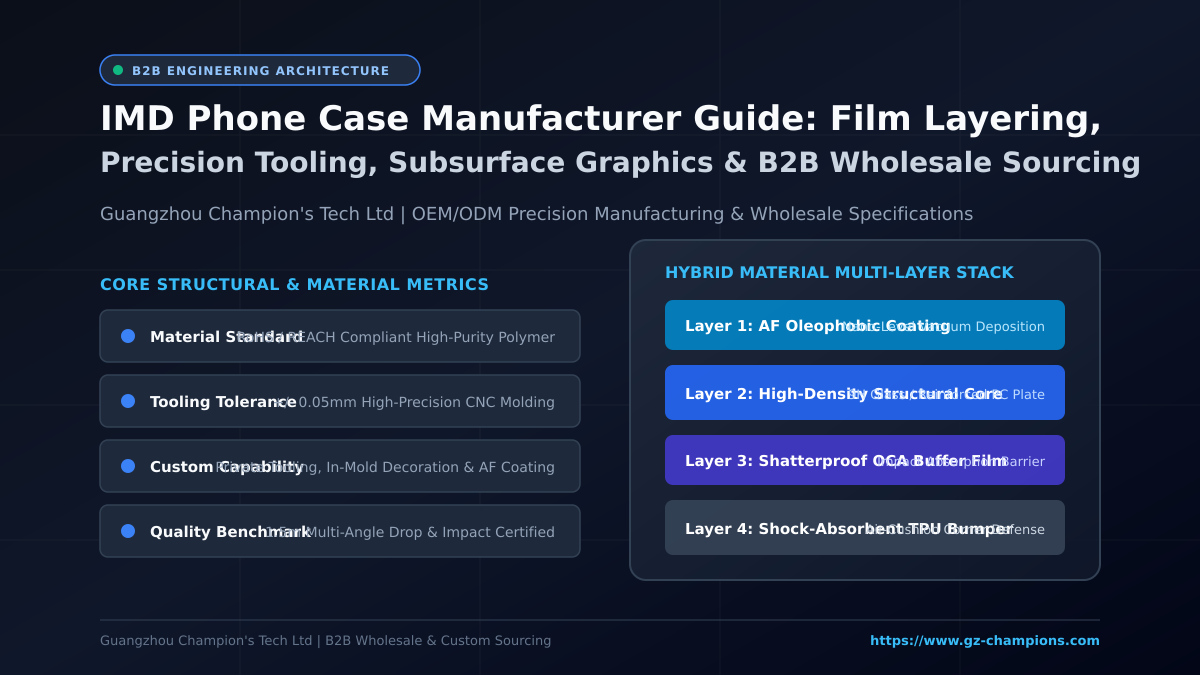
The structural integrity and visual longevity of an IMD smartphone case depend directly upon a cohesive multi-layer laminate architecture. In high-performance OEM production, four distinct material strata are fused under heat and tonnage into a singular composite structure:
1. Optical-Grade Surface Film & Hardcoat Barrier
The outermost layer consists of optical-grade polyethylene terephthalate (PET) or high-clarity polycarbonate (PC) film, typically ranging in thickness from 125 microns to 250 microns (0.125 mm – 0.250 mm). The exterior surface is treated with an acrylic or polysiloxane crosslinked hardcoat barrier formulated to achieve a pencil hardness rating of 2H to 3H. This hardcoat provides resilient defense against daily abrasion from metal keys, coins, and abrasive table surfaces, while simultaneously shielding the underlying graphics from ultraviolet (UV) photodegradation and skin cosmetic oils.
2. Subsurface In-Mold Graphic Inks
Artwork, gradients, photorealistic graphics, and metallic textures are deposited onto the reverse (subsurface) side of the transparent carrier film using specialized high-elongation screen printing inks. These high-temperature formulations incorporate modified polyurethane or acrylic binder resins engineered to stretch up to 200% to 300% during 3D thermoforming without micro-cracking, crazing, or graphic distortion. Because the pigments reside beneath the film, the user never touches the ink directly.
3. Thermal Bonding Adhesive Layer
To establish an unbreakable molecular bond between the decorated film and the molten resin injected behind it, a heat-activated bonding tie-layer (primer) is screen-printed directly over the cured graphics. This specialized adhesive activates when exposed to the extreme thermal mass of molten polycarbonate during injection, preventing interfacial shear delamination across thermal cycling and mechanical drop impacts.
4. Structural Injected Thermoplastic Chassis
The load-bearing core of the protective case consists of virgin optical-grade polycarbonate (PC), impact-modified poly(methyl methacrylate) (PMMA), or a dual-shot PC/TPU hybrid chassis. During back-injection molding, molten plastic is forced behind the formed film insert under high hydraulic pressure (1,200 to 1,800 bar), permanently fusing the carrier film, inks, and structural resin into an indivisible monolithic enclosure.
Engineering Comparison: IMD/IML vs. UV Printing vs. Sublimation
Understanding the fundamental mechanical and economic distinctions between decorative decorating techniques allows B2B buyers to select the appropriate manufacturing process for their commercial volume and retail price tier:
- IMD / IML (In-Mold Decoration / Labeling): Inks are encapsulated subsurface. Scratch resistance is permanent (hardcoat protected). Ideal for commercial runs exceeding 1,000 to 3,000 units per artwork, premium retail brands, and complex 3D curved bumper wraps. Tooling investment includes thermoforming dies and injection molds.
- Direct UV Printing: Inks are deposited on the external surface and cured with ultraviolet light. As explored in our UV printed phone case manufacturer guide, UV printing requires zero thermoforming tooling, making it optimal for ultra-short runs and rapid on-demand customization, though exposed surface inks remain vulnerable to mechanical scuffing over extended handling.
- 2D/3D Vacuum Sublimation: Heat transfers dye directly into a porous polymer coating or sublimation aluminum sheet. While suitable for photographic promotional cases, sublimation lacks the optical depth, metallic foil integration, and tactile texture replication possible with industrial IMD.
- Hybrid Dual-Shot IMD: Fuses a rigid subsurface-decorated IMD polycarbonate backplate with a shock-absorbing TPU perimeter bumper, balancing premium graphics with military-grade drop shock absorption, as detailed in our hybrid phone case manufacturer guide.
The 5-Phase Turnkey IMD Manufacturing Lifecycle
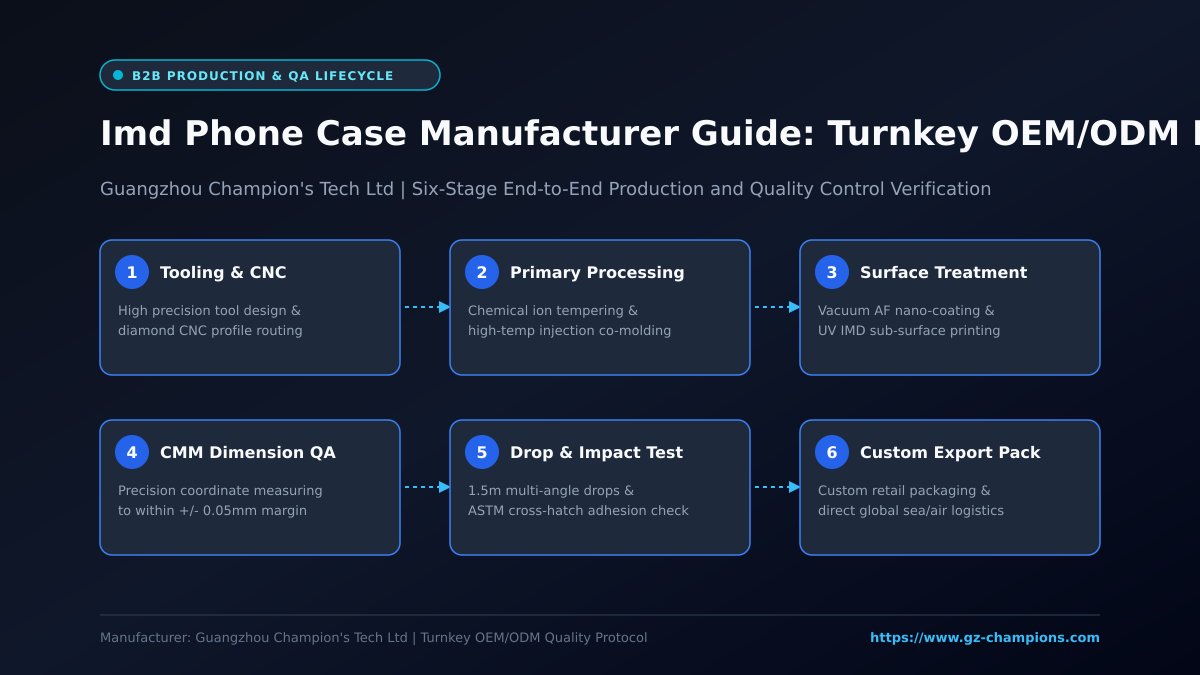
Fabricating high-yield IMD smartphone cases requires rigorous coordination across specialized cleanroom bays, thermal forming presses, and high-tonnage injection cells:
Phase 1: ISO Cleanroom Film Screen Printing & Curing
Multi-color printing occurs inside an ISO Class 7 (Class 10,000) cleanroom environment to eliminate airborne particulate contamination, lint, and dust specks. Automated roll-to-sheet screen printing presses lay down multiple ink layers—including base colors, gradient separations, metallic effect pigments, and opaque white backing passes—with optical alignment tolerances held within ±0.03 mm. Each color pass undergoes infrared or thermal tunnel curing to remove residual solvents.
Phase 2: High-Pressure 3D Thermoforming
The planar printed film sheet is transferred to a high-pressure pneumatic thermoforming machine. The film is radiant-heated to its glass transition temperature (Tg, approximately 135°C to 150°C for PC film), then clamped over a precision CNC-machined forming tool. High-pressure air (up to 30 to 50 bar) forces the softened sheet against the mold cavity, elongating the film into the exact 3D geometry of the smartphone case backplate and corner contours without distorting printed registration markers.
Phase 3: Matched-Die Precision CNC Trimming
Once thermoformed, excess film flange must be sheared off cleanly. Specialized hydraulic trimming presses equipped with high-speed matched-die hardened steel punches (SKD11 tool steel) trim the formed film perimeter, camera cutout ports, and connector apertures. Edge tolerances are strictly maintained within ±0.05 mm. Flawless burr-free edges are mandatory to prevent flash or crushing during subsequent injection molding.
Phase 4: Cleanroom Electrostatic Insertion & Robotic Back-Injection
The trimmed 3D film insert is positioned into the cavity of a precision injection mold by a 6-axis robotic articulation arm equipped with electrostatic neutralization nozzles and micro-vacuum grippers. Electrostatic pinning holds the film flush against the polished cavity wall. The mold closes, and virgin polycarbonate resin is injected behind the film through balanced sub-gates. Controlled mold temperature (80°C to 105°C) and multi-stage injection velocity prevent excessive melt front velocity from washing out printed inks near gate locations.
Phase 5: Annealing, Optical Automated Inspection & Secondary Curing
Ejected molded cases pass through a continuous thermal annealing tunnel to relieve molded-in internal polymer stresses, preventing subsequent warping or micro-cracking around camera bezels. Parts then undergo Automated Optical Inspection (AOI) to inspect for ink voids, cosmetic blemishes, and dimensional conformance before entering cleanroom packaging lines.
Tooling Engineering & Defect Prevention Protocols
Mass-producing IMD phone cases presents intricate mold flow and thermal management challenges. Experienced OEM engineers implement specific tooling design rules and process windows to eliminate common injection defects:
1. Eliminating Ink Washout (Gate Jetting)
When molten resin enters the mold cavity at high velocity, direct melt impingement against the film can scour away printed ink layers. Tooling engineers counter this defect by utilizing fan gates, submarine edge gates, or reverse-side diaphragm gates directed toward non-printed support bosses, reducing gate velocity and introducing resin smoothly across the cavity.
2. Preventing Interfacial Delamination & Film Wrinkling
Wrinkling occurs when the film buckles under uneven thermal expansion or compressive cavity clamp pressure. Engineers optimize forming tool corner radii (minimum R = 1.2 mm to 1.8 mm) and select thermoforming temperatures tailored to the exact orientation of polymer chains. Formulations with matched thermal expansion coefficients (CTE) between the PC carrier film and the injected resin ensure zero interfacial shearing during thermal cycling.
3. Dimensional Warpage Control
Because an IMD case is an asymmetrical composite laminate—with a hardcoated film on one side and an injected polymer core on the other—cooling shrinkage rates differ between front and back surfaces. Precision mold design incorporates conformal cooling water channels and balanced wall thicknesses (target 1.2 mm to 1.5 mm) to guarantee planar flatness within ±0.15 mm across the entire case length.
B2B Procurement Checklist & Technical RFQ Specifications
When requesting quotations from an IMD phone case manufacturer, providing complete technical specifications ensures swift feasibility reviews and accurate tooling quotations:
- Target Smartphone Models: Exact device compatibility (e.g., iPhone 17 / 18 series, Samsung Galaxy S25 / S26, Google Pixel) and required CAD dimensional offsets.
- Film Material & Hardness Spec: Optical PC vs. PET film; 0.125 mm to 0.188 mm thickness; 2H or 3H abrasion-resistant hardcoat specification.
- Chassis Architecture: Single-shot rigid PC backplate vs. co-molded hybrid PC/TPU chassis with internal corner shock air-cushions.
- Magnetic Ecosystem Integration: Internal embedded MagSafe / Qi2 magnetic array (N52 neodymium ring) positioned beneath the backplate or integrated flush within the composite layer.
- Graphic File & Color Matching: Vector CAD/AI artwork separated by color layers, exact Pantone solid coated references, CMYK halftone separations, and metallic foil stamping specifications.
- Tooling Cavitation & Capacity: Single-cavity prototype pilot tooling vs. 2-cavity / 4-cavity hardened steel production tooling (S136 stainless mold steel, 48-52 HRC).
- Reliability & Compliance Verification: Adhesion cross-hatch test (ASTM D3359 Class 5B), RCA abrasion wear resistance (min 300 cycles), RoHS/REACH compliance documentation.
- Packaging & Palletization: Anti-static protective film on both front and back surfaces, custom branded retail packaging, barcode labeling, and moisture-sealed master export cartons.
Partner with Guangzhou Champion’s Tech Ltd for Turnkey IMD Case Manufacturing
Whether you are developing high-fashion retail smartphone accessories, customized gaming editions with metallic subsurface finishes, or durable enterprise cases with embedded branding, Guangzhou Champion’s Tech Ltd provides full-service engineering support from initial industrial design to container dispatch. In addition to advanced IMD manufacturing, our facility excels in private mold phone case development and custom MagSafe case engineering. Contact our technical engineering team today to review your 3D CAD files, request physical sample portfolios, and receive a transparent OEM/ODM tooling quotation.
Ready to Build Your Custom Phone Case Line?
Send your product type, target model, material, packaging request and estimated quantity. The CHAMPIONS team will review the project details and reply with the next steps.