{
“@context”: “https://schema.org”,
“@graph”: [
{
“@type”: “Organization”,
“@id”: “https://www.gz-champions.com/#organization”,
“name”: “Guangzhou Champion’s Tech Ltd”,
“url”: “https://www.gz-champions.com/”,
“logo”: “https://www.gz-champions.com/wp-content/uploads/logo.png”,
“contactPoint”: {
“@type”: “ContactPoint”,
“contactType”: “sales”,
“email”: “karl@gz-champions.com”,
“telephone”: “+86-181-4893-3090”
}
},
{
“@type”: “BreadcrumbList”,
“@id”: “https://www.gz-champions.com/knowledge-center/carbon-fiber-phone-case-manufacturer-guide/#breadcrumb”,
“itemListElement”: [
{
“@type”: “ListItem”,
“position”: 1,
“name”: “Home”,
“item”: “https://www.gz-champions.com/”
},
{
“@type”: “ListItem”,
“position”: 2,
“name”: “Knowledge Center”,
“item”: “https://www.gz-champions.com/knowledge-center/”
},
{
“@type”: “ListItem”,
“position”: 3,
“name”: “Carbon Fiber Phone Case Manufacturer Guide”,
“item”: “https://www.gz-champions.com/knowledge-center/carbon-fiber-phone-case-manufacturer-guide/”
}
]
},
{
“@type”: “WebPage”,
“@id”: “https://www.gz-champions.com/knowledge-center/carbon-fiber-phone-case-manufacturer-guide/”,
“url”: “https://www.gz-champions.com/knowledge-center/carbon-fiber-phone-case-manufacturer-guide/”,
“name”: “Carbon Fiber Phone Case Manufacturer Guide: Real 3K Weave vs Forged Carbon, RF Window Engineering, CNC Tooling & B2B Sourcing”,
“isPartOf”: {
“@id”: “https://www.gz-champions.com/#website”
},
“breadcrumb”: {
“@id”: “https://www.gz-champions.com/knowledge-center/carbon-fiber-phone-case-manufacturer-guide/#breadcrumb”
},
“inLanguage”: “en-US”
},
{
“@type”: “Article”,
“@id”: “https://www.gz-champions.com/knowledge-center/carbon-fiber-phone-case-manufacturer-guide/#article”,
“isPartOf”: {
“@id”: “https://www.gz-champions.com/knowledge-center/carbon-fiber-phone-case-manufacturer-guide/”
},
“headline”: “Carbon Fiber Phone Case Manufacturer Guide: Real 3K Weave vs Forged Carbon, RF Window Engineering, CNC Tooling & B2B Sourcing”,
“description”: “Comprehensive B2B guide for sourcing real carbon fiber phone cases. Learn about authentic 3K tow vs forged carbon composite, RF antenna shielding cutouts, TPU hybrid overmolding, CNC tooling, and factory DFM requirements.”,
“mainEntityOfPage”: “https://www.gz-champions.com/knowledge-center/carbon-fiber-phone-case-manufacturer-guide/”,
“datePublished”: “2026-10-10T09:00:00+08:00”,
“dateModified”: “2026-10-10T09:00:00+08:00”,
“author”: {
“@type”: “Organization”,
“name”: “Guangzhou Champion’s Tech Ltd”
},
“publisher”: {
“@type”: “Organization”,
“name”: “Guangzhou Champion’s Tech Ltd”,
“logo”: {
“@type”: “ImageObject”,
“url”: “https://www.gz-champions.com/wp-content/uploads/logo.png”
}
},
“inLanguage”: “en-US”,
“image”: [
“https://www.gz-champions.com/wp-content/uploads/2026/10/2026-10-10-carbon-fiber-phone-case-manufacturer-guide-architecture-spec.png”,
“https://www.gz-champions.com/wp-content/uploads/2026/10/2026-10-10-carbon-fiber-phone-case-manufacturer-guide-turnkey-workflow.png”
]
}
]
}
Carbon Fiber Phone Case Manufacturer Guide: Real 3K Weave vs Forged Carbon, RF Window Engineering, CNC Tooling & B2B Sourcing
For international consumer electronics brand owners, premium accessory distributors, and automotive lifestyle merchandise retailers, the carbon fiber phone case represents the pinnacle of luxury, structural rigidity, and modern industrial aesthetics. Genuine carbon fiber composite (CFRP) provides an unmatched strength-to-weight ratio, high modulus stiffness, and iconic visual depth that synthetic vinyl wraps and faux-printed plastics cannot replicate. However, manufacturing genuine carbon fiber smartphone enclosures introduces sophisticated engineering challenges: carbon fiber is inherently electrically conductive and shields electromagnetic radio frequency (RF) signals, creates abrasive tool wear during CNC routing, and requires precise thermal compression tooling to avoid resin starvation or micro-porosity defects.
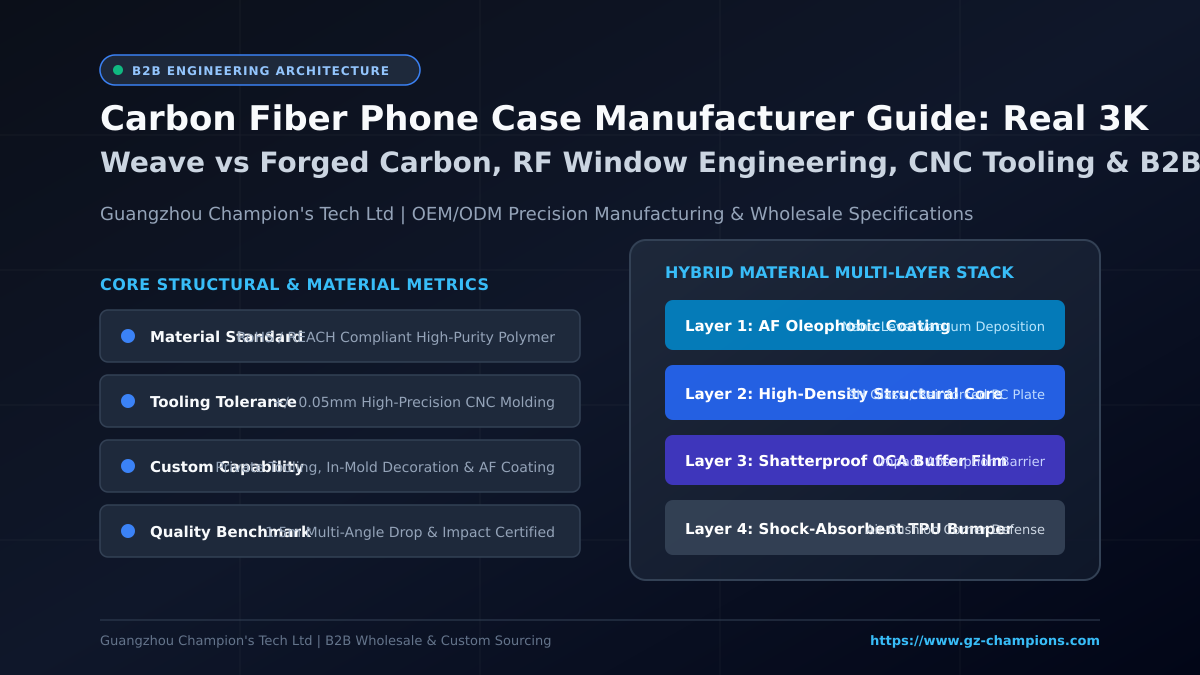
This technical sourcing guide provides procurement teams, hardware product managers, and private-label buyers with actionable manufacturing knowledge. We examine the differences between continuous woven carbon and forged chopped composite, engineering solutions for smartphone antenna transparency (RF windowing and hybrid overmolding), factory compression molding workflows, precision CNC finishing, and essential RFQ specifications required for successful OEM/ODM production partnerships.
Understanding Carbon Fiber Composites: Continuous Weave vs Forged Carbon
Before launching custom tooling, product managers must select the appropriate carbon fiber substrate according to their target market positioning, retail MSRP, and industrial design vision. In commercial smartphone case manufacturing, two primary structural variants dominate the luxury tier:
1. Continuous Woven Carbon Fiber (1K, 3K Plain & Twill Weave)
Continuous woven composite is produced by interlacing carbon fiber yarn bundles (tows). In consumer accessories, the “3K” designation signifies 3,000 individual carbon filament micro-strands per bundle. The tows are woven in either a 1×1 checkerboard plain weave or a 2×2 diagonal twill weave pattern:
- Visual Signature: Displays the classic symmetrical diagonal or square carbon grid, providing high visual symmetry and unmistakable sports-car luxury appeal.
- Mechanical Performance: Offers exceptional bidirectional tensile stiffness and flexural modulus. Under bending force, the continuous filaments distribute shock across the entire surface plate.
- Manufacturing Complexity: Demands precise hand or robotic placement into curved mold cavities to avoid weave distortion, yarn pinch-lines, or pattern asymmetry around corner bends.
2. Forged Carbon Fiber (Chopped Fiber Compression Composite)
Pioneered in exotic aerospace and supercar hypercar components, forged carbon composite utilizes short-strand chopped carbon fiber bundles (typically 6 mm to 15 mm in length) randomly dispersed in a resin paste, then cured under high hydraulic pressure (often exceeding 50 to 80 bar):
- Visual Signature: Creates a distinctive marbled, organic, metallic damascus-steel aesthetic. Because each part features a random fiber distribution, no two phone cases share the identical surface pattern, delivering unique collectibility.
- Isotropic Mechanical Strength: Unlike continuous weave where strength is concentrated along the weave axes, forged carbon exhibits quasi-isotropic mechanical strength in all planar directions.
- 3D Complex Curvature Forming: Chopped fiber paste flows smoothly into tight corner radii, deep recesses, and variable-thickness ribs during molding, significantly reducing fiber bridging and resin void defects.
3. Comparing Authentic Carbon Fiber with Aramid Fiber
B2B buyers frequently weigh carbon fiber against aramid fiber (such as Kevlar). While both are high-performance synthetic composites, their physical properties dictate completely different product architectures. As outlined in our comprehensive aramid fiber phone case manufacturer guide, aramid is an electrical insulator with near-zero RF signal attenuation, allowing full 360-degree snap-on monocoques without signal hindrance. In contrast, carbon fiber is electrically conductive and attenuates 5G, Wi-Fi, and NFC signals when enclosing phone antennas. Consequently, carbon fiber cases require hybrid structural integration or specialized RF cutouts to preserve smartphone communication integrity.
Overcoming Signal Shielding: Antenna Engineering & Hybrid Architectures
The primary technical hurdle in real carbon fiber case design is electromagnetic attenuation. Because carbon filaments conduct electricity, a solid 3D carbon fiber case acts as a partial Faraday cage, which can drop cellular signal strength by 15 dB to 25 dB, degrade Wi-Fi throughput, and disrupt GPS or Qi wireless charging. To solve this without sacrificing premium carbon aesthetics, experienced OEM factories deploy two proven engineering architectures:
Architecture A: Overmolded TPU/PC Hybrid with Carbon Fiber Inset Plate
This is the industry standard for flagship smartphones requiring zero signal loss combined with heavy-duty drop protection. The perimeter bumper and internal chassis are injection molded from high-grade shock-absorbing Thermoplastic Polyurethane (TPU) and rigid Polycarbonate (PC), while a genuine 0.5 mm to 0.8 mm cured carbon fiber plate is mechanically locked or hot-laminated onto the exterior back panel:
- 100% Signal Transparency: The side antenna bands of modern aluminum and titanium smartphone frames remain completely surrounded by non-conductive TPU, ensuring peak 5G NR, Sub-6GHz, and mmWave performance.
- Mil-Spec Shock Absorption: The resilient elastomer perimeter absorbs edge impact forces, overcoming carbon fiber’s inherent brittleness under direct corner impact drops, matching standards seen in our hybrid phone case engineering and shockproof phone case tooling.
- Cost Optimization: Reduces composite raw material consumption and tool cycle times while enabling versatile perimeter textures, lanyard anchors, and independent responsive button covers.
Architecture B: Monocoque Carbon Fiber with Precision CNC RF Windows & Split Bands
For purist luxury brands demanding an ultra-slim, ultra-light continuous carbon shell (under 12 grams), the factory machines precision RF cutouts directly aligned with the smartphone’s internal antenna isolation breaks. The exposed cutout windows are subsequently back-filled with RF-transparent non-conductive polycarbonate resin or matte black aramid fiber patches, seamlessly finished so the visual aesthetic remains continuous while RF signals pass unimpeded.
Step-by-Step OEM/ODM Carbon Fiber Manufacturing Process
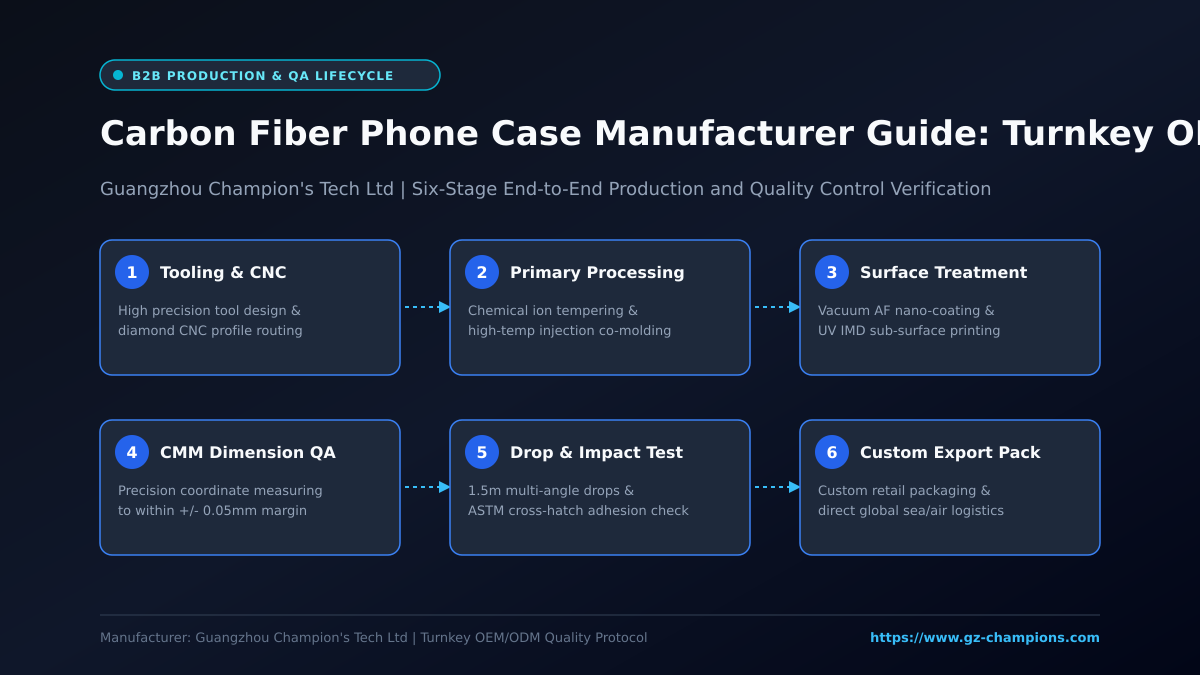
Producing high-yield genuine carbon fiber phone cases requires tight environmental control, specialized composite tooling, and multi-axis CNC finishing. Below is our factory turnkey manufacturing workflow:
Phase 1: Prepreg Staging & Cleanroom Storage
High-grade carbon fiber pre-impregnated fabric (prepreg) with high-clarity epoxy resin is stored in temperature-controlled cold rooms (-18°C) to halt premature resin polymerization. Before production, material is brought to cleanroom ambient conditions and laser-cut into nested blank patterns using computerized flatbed laser plotters.
Phase 2: Tool Steel Mold Layup & High-Tonnage Thermo-Compression
Operators place pre-cut plies into CNC-machined hardened tool steel molds (H13 or P20 grade). The mold is transferred to a hydraulic vacuum thermoforming press. Under temperatures between 135°C and 160°C and hydraulic pressures ranging from 20 to 60 bar, the epoxy resin melts, wets out every carbon tow, purges trapped micro-bubbles through vacuum channels, and cures into a rigid structural matrix.
Phase 3: 5-Axis Robotic CNC Contour Milling
Cured composite blanks are mounted onto vacuum holding fixtures inside enclosed 5-axis CNC machining centers. Because carbon fibers are highly abrasive and prone to delamination under conventional cutting tools, the machining center utilizes Polycrystalline Diamond (PCD) router bits operating at spindle speeds exceeding 28,000 RPM. Robotic pathways carve the outer edge contours, camera bump steps, button cutouts, and interior recess pockets with tolerances held within ±0.05 mm, adhering to our private mold development standards.
Phase 4: Magnetic Ring Array Bonding (MagSafe & Qi2 Integration)
Modern flagship cases require reliable magnetic alignment. In hybrid or monocoque designs, a 0.3 mm recessed circular pocket is milled into the interior backplate. An array of 36 to 38 high-remanence sintered N52 neodymium magnets, encapsulated in a protective flux concentrator plate, is secured using aerospace structural polyurethane adhesive. This delivers over 900 gf of magnetic holding pull force without interfering with internal compass sensors, drawing upon our custom MagSafe case manufacturing expertise.
Phase 5: Robotic Micro-Sanding & Multi-Coat Optical Clear Coating
Each routed case is processed through automated orbital wet sanding to deburr trimmed edges. Parts enter a Class 10,000 dust-free robotic paint booth, where they receive multiple coats of optical-grade polyurethane or automotive clear coat. Buyers can select between:
- High-Gloss Optical Finish: Highlights the 3D optical depth and holographic weave shimmer of genuine carbon filaments.
- Matte Soft-Touch Finish: Provides a refined, non-reflective tactical appearance with anti-fingerprint and oleophobic properties.
Phase 6: Laser Engraving, Interior Flocking & Quality Inspection
High-precision fiber laser etching machines engrave OEM customer logos, regulatory certifications, and individualized batch numbers without damaging the structural carbon plies, following processes detailed in our laser engraved phone case guide. A micro-suede or microfiber flocking inner liner is thermally bonded to protect the smartphone back glass. Finally, automated optical inspection (AOI) cameras evaluate surface weave straightness, resin clarity, and edge finish before dust-free clean packaging.
Quality Control Protocols & Defect Prevention
Composite manufacturing demands relentless quality assurance to prevent common factory defects that can compromise cosmetic appeal and functional durability:
1. Preventing Weave Distortion and Fish-Eye Voids
During mold closure, lateral friction can drag woven tows out of alignment, causing wavy patterns. Our engineering team utilizes precision silicone pressing bladders that exert uniform isostatic pressure, preventing ply slippage and ensuring straight 0°/90° fiber orientation across the entire backplate.
2. Eliminating Edge Delamination and Fiber Pull-Out
Carbon fiber exhibits low interlaminar shear strength compared to its tensile strength. Dull router cutters or aggressive feed rates can force plies apart along cut edges. We implement computerized tool-wear monitoring that retires PCD cutters after 400 linear meters of cutting, supplemented by chilled air tool cooling to keep cut faces mirror-smooth.
3. Coating Adhesion and Cross-Hatch Testing
Epoxy composites possess relatively low surface energy, which can cause clear coats to peel over time under hand sweat and thermal cycling. Before lacquering, cases undergo atmospheric plasma surface activation. Every production batch is validated using ASTM D3359 cross-hatch tape adhesion tests (achieving 5B rating) and 48-hour synthetic sweat immersion tests.
B2B Procurement Checklist & Technical RFQ Specifications
When drafting a Request for Quotation (RFQ) for OEM/ODM carbon fiber phone cases, providing comprehensive engineering parameters ensures rapid DFM review, transparent tooling budgets, and predictable production timelines:
- Target Device Compatibility: Exact device models (e.g., iPhone 17 Pro Max, iPhone 18 series, Samsung Galaxy S26 Ultra) and required CAD fitment clearance envelopes.
- Carbon Substrate Specification: Real 3K Plain Weave, 3K Twill Weave, 1K Micro-Weave, or Forged Chopped Carbon Composite.
- Chassis Architecture: Overmolded TPU/PC hybrid with carbon backplate vs ultra-slim 0.6 mm snap-on monocoque composite.
- Magnetic Ecosystem: Qi2 / MagSafe compatible embedded N52 neodymium magnet ring array with Mu-metal shielding sheet.
- Surface Finish & Sheen: High-gloss mirror polish UV clear coat vs satin matte anti-glare soft-touch coating.
- Branding Execution: Fiber laser surface etching, CNC-machined aluminum camera ring logo, interior hot-foil logo, or metallic electroform badge.
- Interior Lining: Bare cured composite, thermo-embossed microfiber lining, or anti-static silicone spray.
- Mechanical & Environmental Testing: 1.5-meter drop test reliability, RCA tape abrasion rub test (300 cycles), thermal shock (-20°C to 70°C), and RoHS/REACH chemical compliance.
- Packaging & Retail Requirements: Anti-scratch peel-off film, molded EVA foam tray, luxury rigid gift box with magnetic closure, and export carton palletization.
Partner with Guangzhou Champion’s Tech Ltd for Custom Carbon Fiber Case Manufacturing
Guangzhou Champion’s Tech Ltd is an experienced B2B OEM/ODM manufacturing partner specializing in advanced composite and hybrid protective mobile accessories. Our facility integrates precision CNC mold tooling, automated composite compression presses, 5-axis robotic milling stations, and cleanroom finishing lines to deliver high-yield production runs with exacting tolerances. Beyond carbon fiber solutions, our production capabilities encompass liquid silicone phone cases, tempered glass phone cases, and advanced IMD phone case manufacturing. Contact our engineering team today with your 3D CAD files or project requirements to receive comprehensive DFM analysis, physical material swatches, and a detailed manufacturing quotation.
Ready to Build Your Custom Phone Case Line?
Send your product type, target model, material, packaging request and estimated quantity. The CHAMPIONS team will review the project details and reply with the next steps.