
In the premium mobile protection sector, aramid fiber phone cases represent the pinnacle of strength-to-weight engineering. Often recognized under the DuPont trade name Kevlar, synthetic para-aramid filament yarns offer five times the tensile strength of steel on an equal-weight basis, combined with high thermal resistance and complete electromagnetic neutrality. For international consumer electronics brands, accessory distributors, and private-label buyers, developing custom aramid fiber phone cases requires an in-depth understanding of specialized composite manufacturing, precision mold tooling, multi-axis CNC trimming, and surface coating chemistry.
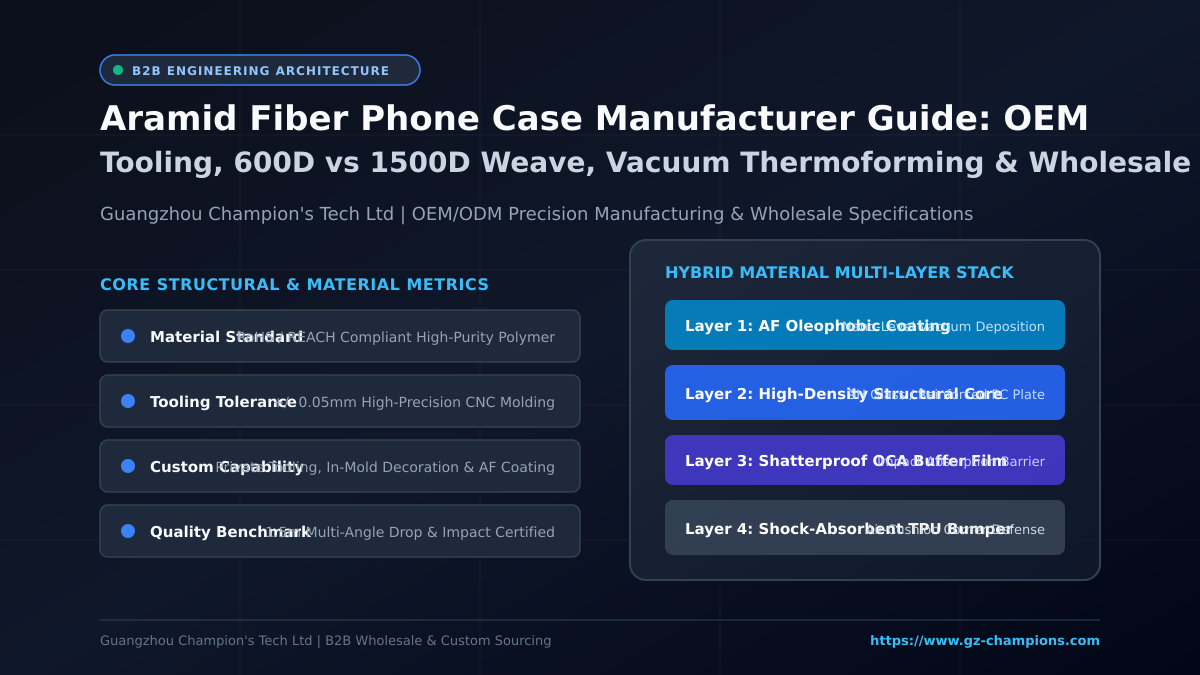
Unlike conventional polycarbonate or TPU injection molding, composite aramid fiber case production relies on prepreg weaving, resin infusion, high-temperature vacuum thermoforming, and precision robotic machining. This engineering guide examines the core technical parameters, structural architectures, turnkey manufacturing stages, and B2B procurement specifications essential for selecting a reliable OEM/ODM phone case manufacturer for your next aramid product line.
Why Aramid Fiber Dominates Ultra-Slim High-End Device Protection
Consumer demand for minimalist, featherlight protective cases that preserve the industrial ergonomics of flagship smartphones—such as the iPhone 17 and 18 series or Samsung Galaxy flagflags—has driven rapid market adoption of aramid fiber composites. B2B product planners favor aramid fiber for several definitive technical advantages:
- Unmatched Strength-to-Thickness Ratio: Aramid composite shells can be manufactured to wall thicknesses as thin as 0.60 mm to 0.85 mm while maintaining exceptional puncture resistance and structural rigidity under high-impact torsional stress.
- Zero Electromagnetic Shielding (Zero Signal Loss): Unlike conductive carbon fiber, which blocks 5G cellular frequencies, Wi-Fi, Bluetooth, NFC, and wireless inductive charging coils, aramid fiber is fully dielectric and radio-frequency transparent. Smartphones retain 100% signal throughput without necessitating antenna cutout windows.
- Thermal Stability & Flame Retardancy: Aramid fibers exhibit no melting point, decomposing only above 450°C, and provide excellent thermal insulation against intensive battery discharge during fast Qi2 charging.
- Distinctive Woven Aesthetic & Tactile Ergonomics: The natural optical depth of twill and plain weave aramid, enhanced by non-slip soft-touch resin topcoats, creates an unmistakable premium executive feel that commands superior retail margins.
Aramid Fiber vs Carbon Fiber vs Hybrid TPU/PC: Engineering Comparison
Selecting the right protective substrate depends on functional requirements, wireless compatibility, and target price points. The following engineering comparison illustrates the key physical properties across leading composite and polymer solutions:
| Engineering Metric | Para-Aramid Fiber (600D / 1500D) | Real Carbon Fiber (3K Tow) | Hybrid Rigid TPU + PC |
|---|---|---|---|
| Base Material Type | Aromatic Polyamide Synthetic Polymer | Polyacrylonitrile (PAN) Carbon Matrix | Thermoplastic Polyurethane & Polycarbonate |
| Typical Wall Thickness | 0.60 mm – 0.90 mm (Ultra-Slim) | 0.70 mm – 1.00 mm (Rigid) | 1.40 mm – 2.20 mm (Standard Protective) |
| Typical Case Weight | 11 g – 16 g | 13 g – 18 g | 28 g – 45 g |
| RF & 5G Signal Permeability | 100% Transparent (Zero Loss) | Conductive (Attenuates Signal significantly) | 100% Transparent (Zero Loss) |
| NFC / Qi2 Wireless Charging | Fully Compatible & Optimized | Requires Antenna Cutouts / Gaps | Fully Compatible |
| Impact Energy Dissipation | High Toughness & Flexural Energy Absorption | Brittle under localized shock impacts | High Elastic Damping via TPU perimeter |
| Tooling & Unit Cost Tier | High / Premium Composite | High / Premium Composite | Low to Moderate / High-Speed Molding |
For brands seeking heavier drop cushioning while preserving the woven look of aramid, many OEM projects adopt an overmolded composite hybrid design. Here, a pre-formed aramid backplate is insert-molded into an impact-absorbing TPU perimeter chassis, combining 10-foot drop absorption with composite elegance, as detailed in our guide to hybrid phone case manufacturing.
Selecting Aramid Filament Specifications: 600D vs 1500D Weaves
In aramid manufacturing, “Denier” (D) designates the linear mass density of the filament yarn, defined as the mass in grams per 9,000 meters of filament. For smartphone cases, two primary denier specifications dominate the supply chain:
1. 600D Ultra-Fine Weave (High-Density Premium)
600D aramid utilizes extremely fine filaments woven at roughly double the yarn density of standard composite textiles. The individual fiber bundles are thinner and tighter, resulting in an exceptionally smooth, micro-textured surface with virtually imperceptible yarn steps. Tooling with 600D allows for tighter edge radii (down to R0.8 mm) around camera corners and speaker ports. However, due to raw yarn supply constraints and specialized slow weaving speeds, 600D material costs approximately 30% to 50% more than 1500D.
2. 1500D Classical Weave (Durable Industrial Benchmark)
1500D yarn is thicker, producing the classic bold, high-contrast diagonal twill or plain weave structure. It provides slightly higher impact puncture resistance per layer and offers higher production yield rates during vacuum forming. 1500D represents the most cost-effective solution for large-scale B2B distribution and corporate merchandise channels.
3. Twill Weave vs Plain Weave vs Jacquard Color Patterns
Beyond denier, tooling designers can specify weaving patterns:
- Plain Weave (1×1): Symmetrical checkerboard pattern offering balanced multi-directional tensile stability.
- Twill Weave (2×2): Classic diagonal rib appearance offering superior drapeability around 3D curved corners.
- Colored Aramid Jacquard Blends: Doped-dyed aramid yarns blended with colored Vectran or polyester filaments to produce bespoke carbon-red, racing-blue, or titanium-gold geometric patterns without compromising structural integrity.
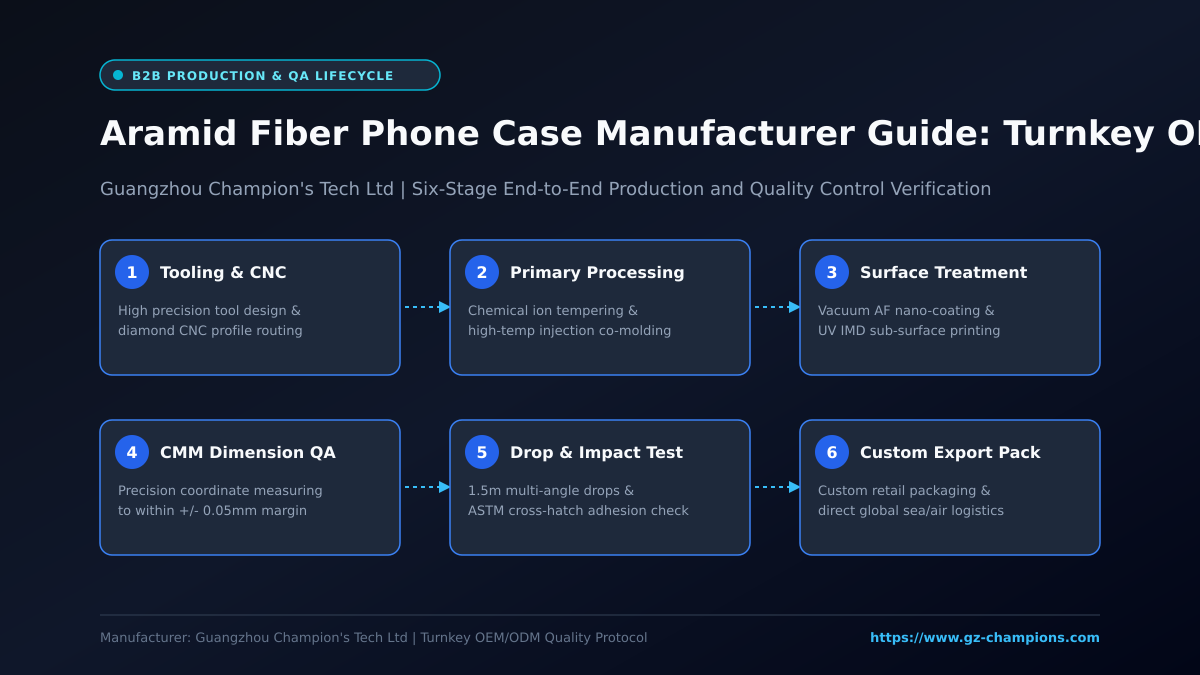
The 6-Phase Turnkey Aramid Fiber Manufacturing Process
Transforming flexible woven aramid textiles into rigid, dimensionally stable smartphone enclosures involves an intricate sequence of composite engineering operations:
Phase 1: Prepreg Preparation & Vacuum Autoclave Impregnation
Raw aramid fabric rolls are impregnated with a proprietary thermosetting epoxy or modified phenolic resin matrix. The resin content is precisely metered to 38%–42% by weight. Too little resin causes dry fiber flaking; excess resin adds unnecessary weight and risks surface micro-cracking. Prepregs are stored in climate-controlled cleanrooms to prevent premature ambient curing.
Phase 2: Computerized Ply Nesting & High-Tonnage Heated Hydraulic Forming
Multi-ply prepreg sheets (typically 2 to 4 plies arranged in quasi-isotropic 0°/90° or ±45° orientations) are cut to precision profile blanks. The stacked plies are placed into high-precision tool steel molds. Heated vacuum compression presses apply temperatures between 140°C and 165°C under 15 to 25 bar of hydraulic pressure. The resin flows through the yarn bundles, cures, and solidifies into a rigid 3D monocoque shell matching the exact outer geometry of the target smartphone.
Phase 3: Multi-Axis Robotic CNC Contour Trimming
Because cured aramid fibers are extraordinarily tough and resistant to cutting, conventional mechanical stamping tears and frays the material. Monocoque shells are secured in custom vacuum chuck fixtures and processed by 5-axis high-speed CNC robotic milling spindles equipped with diamond-coated (PCD) router bits. CNC cutting paths carve out the camera bump apertures, side button slots, USB-C ports, and speaker grill arrays at tolerances within ±0.05 mm, utilizing our dedicated private mold tooling standards.
Phase 4: Magnetic Ring Array Integration (MagSafe & Qi2 Compatibility)
For modern flagship devices, seamless magnetic accessory alignment is mandatory. In premium aramid cases, a 0.25 mm ultra-thin recessed pocket is CNC-machined into the interior shell surface. A ring of 36 to 38 segmented N52 grade sintered neodymium magnets, backed by a high-permeability magnetic flux shielding sheet, is bonded using aerospace-grade structural epoxy. This ensures strong magnetic breakaway pull force (over 900 gf) without adding external bulk or demagnetizing smartphone interior compass sensors, complementing our custom MagSafe case manufacturing technology.
Phase 5: Automated Surface Sanding & Tactile Protective Coating
Each trimmed shell undergoes automated wet sanding and micro-grit blast cleaning to eliminate edge burrs and resin flash. The shells pass into an automated cleanroom spray line where they receive multiple coats of UV-curable soft-touch polyurethane or scratch-resistant ceramic matte lacquers. This protective coating prevents UV yellowing, enhances sweat and fingerprint resistance, and provides a warm, tactile hand grip.
Phase 6: Laser Branding, Interior Micro-Flocking & AOI Inspection
Brand logos, regulatory CE/FCC markings, and batch serials are applied using sub-micron fiber laser etching, as detailed in our guide to laser engraved phone case manufacturing. Premium variants receive an interior thermo-laminated microfiber or soft-touch flocking lining to prevent friction scratches on smartphone back glass. Finally, Automated Optical Inspection (AOI) cameras verify weave symmetry, edge deburring, and dimensions before individual anti-static packaging.
Engineering Challenges & Defect Prevention Protocols
High-yield aramid composite manufacturing demands stringent process discipline to overcome notorious material pitfalls:
1. Preventing Edge Fraying and Delamination during CNC Machining
Due to aramid’s high tensile ductility, dull cutting tools pull and shred fibers rather than shear them cleanly, creating “furry” edge fringes. Factory engineering teams mitigate this by strictly controlling PCD router tool life (replacing cutters every 350 cycles), operating spindles at 30,000+ RPM, and applying cryogenic cold-air cooling blasts during machining.
2. Eliminating Void Entrapment and Resin Starvation
Complex 3D curvature around smartphone corners can entrap air bubbles during rapid mold clamping, causing structural voids. Tier-1 mold designs incorporate vacuum venting ports and multi-stage pressure ramp profiles, ensuring 100% resin wetting across tight corner radii.
3. Maintaining Planar Flatness and Eliminating Thermal Warpage
Asymmetrical cooling post-cure can cause thin aramid shells to twist or bow outward, leading to loose smartphone fitment. Molds utilize balanced dual-zone conformal oil heating channels, and post-cure parts undergo controlled cooling on precision aluminum cooling fixtures to lock in dimensional accuracy within ±0.08 mm.
B2B Procurement Checklist & Technical RFQ Specifications
When issuing a Request for Quotation (RFQ) to an OEM/ODM aramid phone case factory, providing exhaustive technical requirements accelerates tooling timelines and guarantees quote precision:
- Target Device Specifications: Exact device model names (e.g., iPhone 17 Pro, iPhone 18 Pro Max, Galaxy S25 Ultra) and required CAD fitment clearance parameters.
- Weave Specification & Tow Size: 600D ultra-fine vs 1500D standard; Plain weave (1×1) vs Twill (2×2) vs custom colored Jacquard weave.
- Chassis Architecture: Ultra-slim snap-on composite monocoque (0.7 mm wall) vs overmolded TPU/PC hybrid with full-coverage bumper edges.
- Magnetic Ecosystem: Qi2 / MagSafe compatible N52 neodymium magnetic ring array with integrated Mu-metal or ferrite flux shielding layer.
- Surface Coating & Finish: Matte soft-touch polyurethane, semi-gloss scratch-resistant ceramic clear coat, or hydrophobic anti-fingerprint coating.
- Branding Integration: Precision CNC interior logo pocket, exterior fiber laser engraving, metal electroform emblem badge, or metallic hot foil stamping.
- Reliability & Testing Standards: 100-cycle steel wool abrasion resistance, RCA tape rub test (ASTM F2357), sweat and chemical resistance tests, thermal shock (-20°C to 65°C), and RoHS/REACH chemical compliance.
- Packaging & Retail Assembly: Anti-scratch PE protective film, EVA tray in custom rigid magnetic gift box, barcoding, and master carton export palletization.
Partner with Guangzhou Champion’s Tech Ltd for Custom Aramid Phone Case Manufacturing
Guangzhou Champion’s Tech Ltd is a premier OEM/ODM manufacturer specializing in precision composite and hybrid protective mobile accessories. Our facility integrates CNC mold machining, vacuum thermoforming presses, robotic 5-axis trimming centers, and cleanroom coating lines to deliver high-yield production runs with rigorous dimensional tolerances. Beyond aramid fiber solutions, we provide comprehensive manufacturing across liquid silicone phone cases, tempered glass phone cases, and custom UV printed cases. Contact our engineering team today with your 3D CAD files or project concept to receive technical DFM feedback, physical material swatches, and a competitive manufacturing proposal.
Ready to Build Your Custom Phone Case Line?
Send your product type, target model, material, packaging request and estimated quantity. The CHAMPIONS team will review the project details and reply with the next steps.