Natural wood phone cases occupy a distinguished segment in consumer electronics accessories, blending organic tactile luxury with bespoke craftsmanship. For premium consumer brands, lifestyle retailers, and corporate gifting distributors, natural timber phone covers present an attractive eco-luxe narrative. However, engineering timber for thin-profile consumer electronics covers involves unique mechanical challenges that pure synthetic plastics do not face: natural grain hygroscopy, directional splitting under impact, thermal warpage, and strict adhesion requirements across heterogeneous material interfaces.
When procurement teams evaluate an OEM/ODM partner for natural wood smartphone covers, distinguishing between fragile unibody timber carvings and robust engineered wood-composite hybrid architectures is critical. This B2B guide provides engineering benchmarks, timber species comparisons, CNC machining tolerances, MagSafe magnet array integration standards, and factory quality checklists for container-scale production.
Engineering Architectures: Pure Timber Carvings vs. Engineered Hybrid Veneers
In commercial mass production, wood phone cases are manufactured primarily through two structural methodologies: monolithic solid-carved timber and multi-layer wood veneer hybrid composites.
1. Monolithic Solid Wood Shells (CNC Subtractive Machining)
Monolithic timber cases are carved entirely from a single solid block of kiln-dried hardwood using multi-axis CNC milling centers. While celebrated by artisan woodworkers for pure timber purity, monolithic wood cases exhibit significant structural vulnerabilities in real-world consumer use:
- Grain Cleavage and Brittleness: Solid wood has directional grain alignment. Thin wall sections (such as camera bezel rims and side port cutouts under 1.2 mm) are prone to snap upon baseline drop impact or everyday snap-on installation stresses.
- Hygroscopic Expansion and Dimensional Creep: Solid wood breathes and absorbs atmospheric moisture. In fluctuating relative humidity (RH 30% to 85%), unibody wood can swell or shrink by 0.4 mm to 0.8 mm, causing either loose phone retention or cracked display screen edges.
- Manufacturing Yield: Solid carving experiences higher scrap rates (often 15% to 25%) due to natural subsurface knots, fissures, and warp during stress release in CNC hogging.
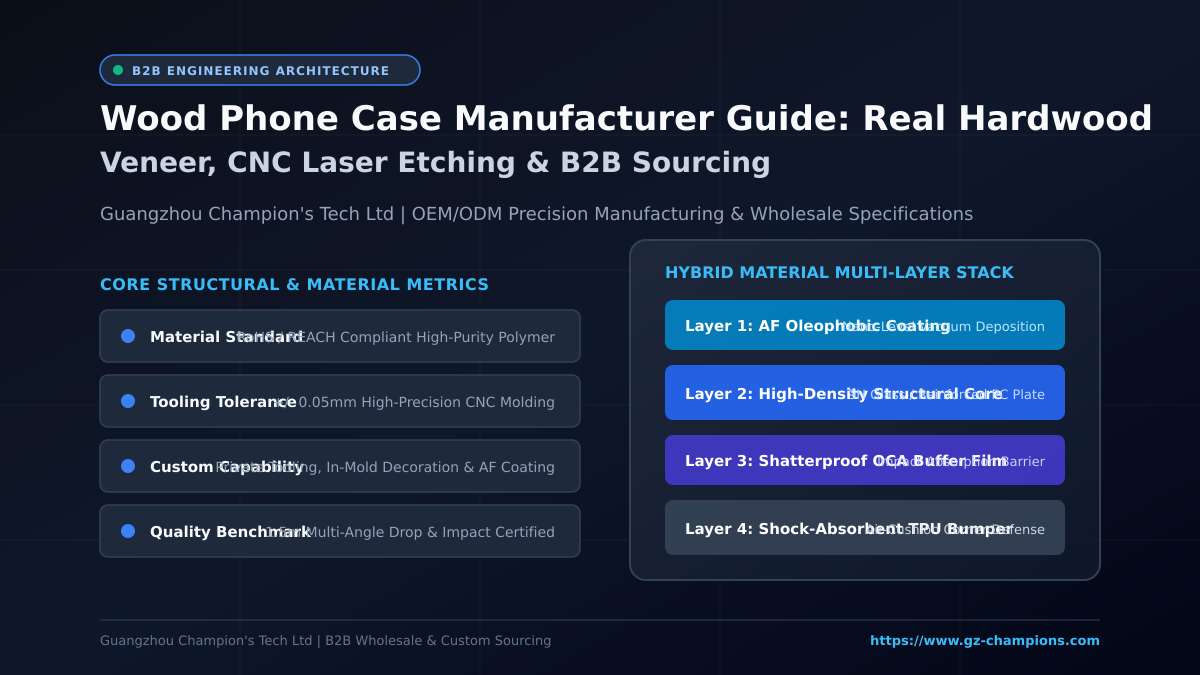
2. Engineered Wood-Hybrid Architectures (Veneer + Kevlar/PC Substrate + TPU Bumper)
To overcome solid wood fragility while retaining authentic organic aesthetics, commercial B2B OEM manufacturing relies on engineered composite laminates. Champion’s utilizes a multi-layer hybrid architecture:
- Outer Decorative Layer: Real natural hardwood veneer shaved to 0.40 mm – 0.60 mm thickness, stabilized under hydraulic heat-press lamination with anti-shatter backing fabric.
- Structural Reinforcement Core: An ultra-thin rigid Polycarbonate (PC) or woven glass-fiber/aramid layer (0.35 mm – 0.50 mm) bonded beneath the veneer to distribute drop shock and neutralize cross-grain tensile splitting.
- Impact Absorption Perimeter: Flexible, high-rebound Thermoplastic Polyurethane (TPU) bumper (durometer 85A – 90A) precision molded around the edges with internal corner shock cavities.
- Interfacial Bonding: Industrial-grade thermosetting polyurethane (PUR) adhesive applied under automated pneumatic pressure, guaranteeing bond integrity without delamination across -20 C to +70 C operating environments.
Timber Substrates: Sourcing Characteristics and Machining Comparison
Selecting the appropriate timber species directly dictates CNC engraving clarity, oil absorption, flexural strength, and long-term grain stability. Factory procurement teams evaluate timber species across empirical density, stability, and machining behavior:
| Timber Species | Density & Hardness (Janka) | Natural Color & Grain Tone | Laser Etching & CNC Response | Hygroscopic Stability |
|---|---|---|---|---|
| Black Walnut (Juglans nigra) | Medium-Dense (~1,010 lbf) | Deep chocolate brown to dark amber; wavy interlocking grain | Exceptional contrast; deep, crisp dark-brown char lines without scorch bleed | High; low shrinkage coefficient; premium commercial market standard |
| Moso Bamboo (Phyllostachys edulis) | High Hardness (~1,380 lbf) | Golden amber to caramelized blonde; linear striation grain | Uniform fiber burn; micro-smooth edges; excellent dimensional tensile stiffness | Very High; engineered ply structure resists radial twisting |
| American Cherry (Prunus serotina) | Medium (~950 lbf) | Warm reddish-pink darkening with UV light; fine satin luster | High resolution for intricate logos; subtle, warm caramelized engraving contrast | Moderate; requires precision oil-seal finish to prevent grain raising |
| Rosewood (Dalbergia veneer) | Dense Hardwood (>1,700 lbf) | Rich reddish-brown with prominent dark streaks; natural oily sheen | Fine detailing; requires tuned laser frequency to cleanly cut oily resin fibers | High; natural resin oils offer intrinsic water repellency |
| Maple (Acer saccharum) | Dense Hardwood (~1,450 lbf) | Light cream to pale blonde; fine tight grain structure | High contrast dark-brown burn mark on blonde substrate; perfect for raster art | Moderate; requires stable kiln-drying (moisture content 8% – 10%) |
Precision Customization: Laser Engraving, Inlays & Surface Finishing
Natural wood cases provide a versatile canvas for B2B branding, artisan retail lines, and private-label customization through industrial tooling:
1. High-Precision CO2 / Fiber Laser Etching
Unlike surface pad printing which can wear away over time, laser engraving selectively vaporizes timber fibers at focal depths of 0.15 mm to 0.40 mm. By modulating pulse width, beam velocity, and laser wattage (30W – 60W CO2 laser galvo heads), factories achieve distinct visual depths: from fine vector outline branding to deep multi-pass 3D topographic textures. Edge char is scrubbed with micro-abrasive media before topcoat application.
2. Resin Inlays and Multi-Timber Marquetry
For high-value custom product lines, OEM manufacturers offer multi-veneer marquetry and colored epoxy resin inlays. CNC routers pocket 0.35 mm cavities into the face veneer, into which contrasting wood cutouts (e.g., Maple emblems seated into Walnut chassis) or tinted liquid epoxy resin are cast, heat-cured, and sanded flush to optical coplanarity (+/- 0.05 mm surface step).
3. Hydrophobic Protective Topcoats (Natural Wax vs. Matte UV Lacquer)
Raw timber exposed to skin sebum, sweat, and hand sanitizer quickly stains and degrades. Factory surface treatments balance natural timber warmth against industrial environmental durability:
- Natural Botanical Oils & Beeswax: Preserves raw wood tactile breathing, micro-grain warmth, and authentic matte texture; optimal for artisanal eco-lifestyle collections. Requires periodic consumer conditioning.
- Matte Polyurethane / UV-Cured Acrylic Sealers: Seals micro-pores with an invisible, non-yellowing protective film. Formulated to pass 48-hour synthetic sweat immersion, 75% alcohol wipe resistance (50+ double rubs), and Taber abrasion tests while keeping specular gloss under 10 GU.
MagSafe Magnetic Array Integration into Wood Chassis
Integrating wireless magnetic alignment arrays into natural wood cases presents tight spatial tolerance constraints. The total backplate thickness of a protective case must not exceed 2.0 mm to 2.2 mm to preserve Qi/Qi2 wireless charging efficiency and maintain over 800 – 1000 gf magnetic holding force.
Champion’s incorporates an engineered recessed internal cavity within the PC mid-frame beneath the wood veneer layer:
- Magnet Grade: Sintered Neodymium-Iron-Boron (NdFeB) N52 or N54H arc magnets with high remanence (Br >= 1.42 T) and high thermal demagnetization resistance (up to 120 C).
- Shielding Permalloy Ring: A 0.15 mm stamped silicon-steel back flux concentrator plate focuses magnetic lines toward the external accessory while shielding the internal battery, preventing eddy current thermal dissipation during 15W high-speed charging.
- Veneer Distance Optimization: The timber veneer directly covering the magnetic ring is precision-calibrated to 0.45 mm +/- 0.05 mm. This guarantees that magnetic field attenuation remains below 12%, ensuring secure retention on automobile magnetic mounts and desktop wireless docking stations.
Turnkey B2B Sourcing & Manufacturing Workflow
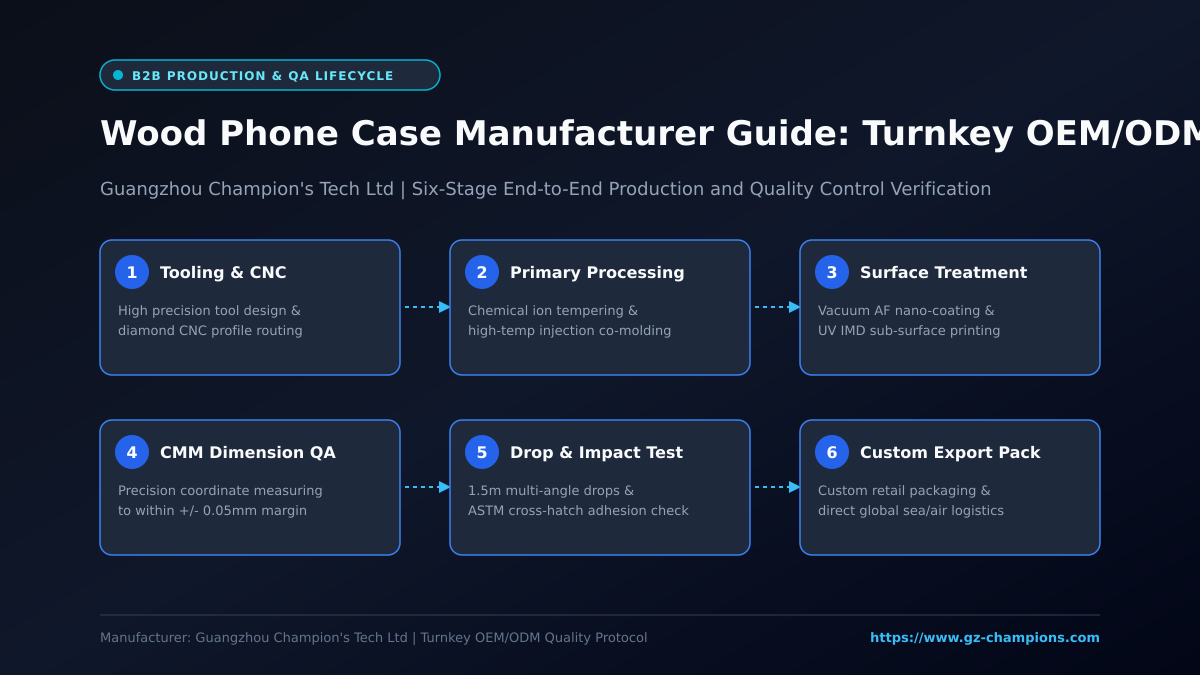
Executing an OEM/ODM wood smartphone case program from design validation through container shipment follows an 8-stage turnkey gate process:
- DFM & CAD Engineering: Evaluation of 3D device dimensions, camera ring drop protection clearance (+0.8 mm raised lip), button actuation tactile feel, and veneer pocket geometry.
- Timber Sourcing & Kiln Stabilization: Selecting certified hardwood logs, slicing veneers, and vacuum kiln drying to 8% – 10% equilibrium moisture content (EMC).
- Lamination & Structural Bonding: Thermosetting PUR adhesive lamination of wood veneer to structural PC core plates under high-pressure heated platens.
- Precision Multi-Axis CNC Profiling: Automated edge contour routing, camera hole chamfering, and connector port trimming.
- Custom Laser Engraving / Inlay: Automated galvo-laser etching of buyer logos, custom graphics, or resin cast curing.
- Secondary Overmolding / Assembly: Combining the finished wood backplate with precision-injected TPU perimeter bumpers.
- Sand & Protective Finish Coating: Three-stage orbital micro-sanding (up to 800 grit), followed by automated spray application and UV oven curing of protective sealers.
- B2B Quality Assurance & Custom Packaging: 100% cosmetic inspection, drop testing, barcode labeling, and moisture-controlled bulk master carton packing with desiccant packs.
Factory Quality Control & Sourcing Checklist
Before issuing mass-production purchase orders for wood smartphone covers, brand buyers and procurement agents should evaluate OEM suppliers against these 8 inspection criteria:
- Moisture Content Calibration: Verify that factory wood veneers are tested with pinless moisture meters upon incoming inspection (acceptable range: 8% to 11% EMC). Excess moisture causes mold and subsequent warping; dry veneers (<6%) shatter during snap fit.
- Interfacial Adhesion Cross-Hatch Test: Perform ASTM D3359 cross-hatch tape adhesion testing on the veneer-to-plastic substrate bond line (Target: Class 4B or 5B with zero veneer lifting).
- Drop Impact Durability: Sample assemblies must survive 1.2-meter drop tests (MIL-STD-810H Method 516.8) onto steel-reinforced concrete across 26 drop orientations without veneer detachment or corner bumper fracturing.
- Thermal Shock & Climate Chamber Cycling: 72-hour environmental test chamber exposure cycling between -20 C (dry) and +60 C (90% RH) to confirm zero veneer warping, bubbling, or delamination.
- Chemical & Sweat Resistance: Continuous 24-hour artificial perspiration contact test followed by 50 cycles of 75% isopropyl alcohol rub to ensure surface finish stability.
- Dimensional Port & Button Tolerances: CMM or optical profile projector inspection verifying +/- 0.10 mm tolerance on camera bezels, tactile button travel, and USB-C port clearances.
- Wireless Charging & MagSafe Flux Verification: Magnetic pull force gauge verification achieving >= 850 gf on standard MagSafe accessories, with Qi charging efficiency verified at 15W without excessive heat generation.
- Grain Aesthetic Grading: Strict cosmetic boundary samples (Golden Samples) defining allowable natural grain variations, mineral streaks, and knot tolerances to prevent bulk shipment disputes.
Frequently Asked Questions (FAQ) for B2B Buyers
What is the typical production lead time and MOQ for custom wood phone cases?
For standard timber species (Walnut, Bamboo, Cherry) utilizing existing factory tooling for popular iPhone and Samsung Galaxy flagships, pilot production typically starts at low volume thresholds. Custom private tooling or specialized exotic timber species requires additional mold fabrication and wood sourcing lead times. Contact our engineering team for precise project quotations.
Can natural wood cases support full-color UV printing alongside laser engraving?
Yes. Many clients combine laser-etched linework with multi-pass industrial UV color printing to produce hybrid artwork with tactile grain texture. Specialized white ink underbases are applied to prevent the dark wood grain from muting bright color artwork.
How do you prevent natural wood cases from warping in tropical or humid shipping environments?
Warpage is prevented by utilizing 0.5 mm stabilized hybrid veneer backings bonded to high-modulus PC substrates under hydraulic PUR heat lamination, sealed with hydrophobic UV coatings, and packed inside moisture-barrier inner packaging with active silica gel desiccant packs.
Request an Engineering Consultation & OEM Sample Kit
Whether developing an executive lifestyle collection, corporate branded merchandise, or an eco-luxury smartphone accessory line, Guangzhou Champion’s Tech Ltd provides turnkey DFM engineering, rapid laser prototyping, and rigorous bulk manufacturing. Explore our comprehensive OEM/ODM manufacturing services, examine our custom capabilities, or browse our Knowledge Center for technical manufacturing insights.
Ready to Build Your Custom Phone Case Line?
Send your product type, target model, material, packaging request and estimated quantity. The CHAMPIONS team will review the project details and reply with the next steps.