
TPU Phone Case OEM Guide: Material Selection, Molding Design and QC
Bottom line: A TPU phone case program succeeds when the buyer locks the device matrix, TPU grade, wall and draft strategy, decoration, and inspection evidence before tooling. TPU is a flexible thermoplastic elastomer used in injection molding; supplier references describe abrasion resistance, impact absorption and low-temperature flexibility, but the finished case depends on the selected grade and process. Treat the values below as design-review starting points, not CHAMPIONS test results or a performance guarantee.
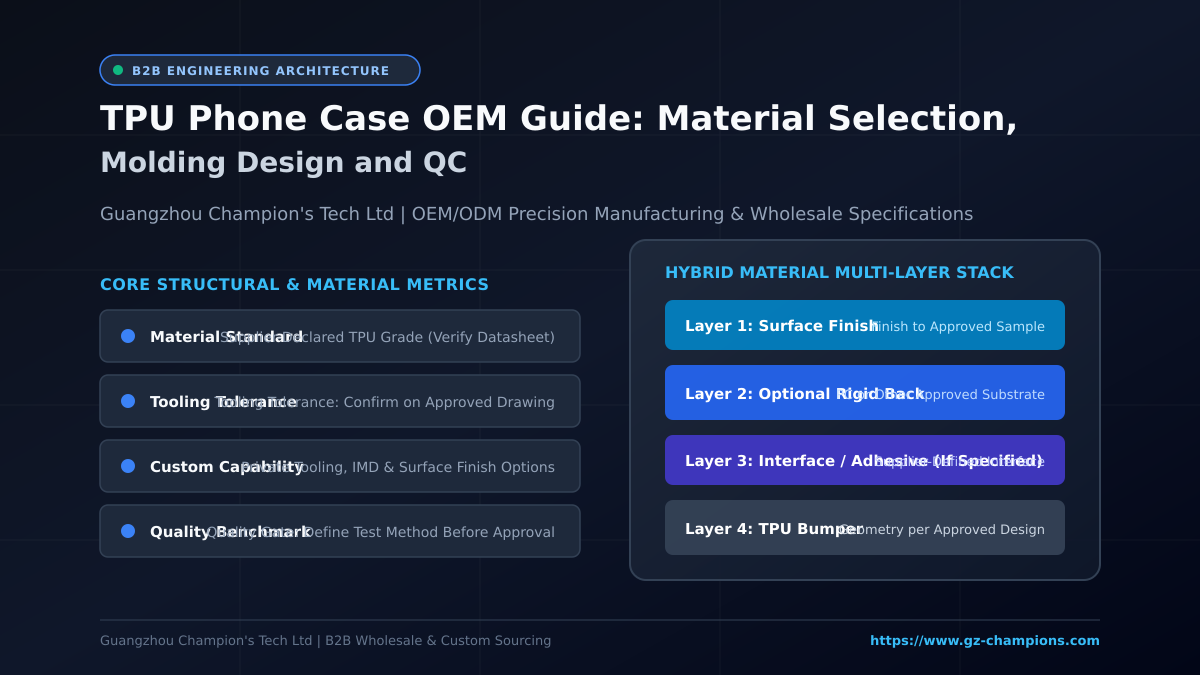
This guide is for distributors, private-label teams and product engineers comparing an OEM/ODM TPU phone case supplier. It combines general manufacturing references with a practical RFQ and sample gate. DataForSEO supplied the target keyword and live SERP response; the readable technical references are explicitly marked as AnySearch fallback because the SERP pages themselves did not expose usable article bodies.
1. Define the TPU case brief before requesting a quote
“TPU case” can mean a clear flexible shell, a colored bumper around a rigid PC back, or a TPU overmold on another substrate. Send a structured brief so a supplier quotes the same product you intend to sell.
| Brief item | Specify in the RFQ | Why it changes the program |
|---|---|---|
| Device matrix | Exact model, regional variant, camera layout and revision | Each opening and fit surface can require a separate insert or tool. |
| Construction | Single TPU shell, TPU bumper plus PC back, or TPU overmold | Material compatibility, gates, assembly and inspection points differ. |
| Material grade | Hardness target, color, clarity, polyester/polyether family and supplier datasheet | Grade affects flow, shrinkage, hydrolysis behavior, feel and finish. |
| Decoration | Blank, color match, UV print, IMD, laser mark or texture | Surface preparation, mold texture and artwork approval become part of QC. |
| Commercial route | Prototype, private mold, repeat OEM or wholesale stock | Tool ownership, revision control, packaging and replenishment evidence must be clear. |
2. Choose the TPU chemistry by use case, not by the word “TPU”
Hubs describes TPU as a thermoplastic elastomer commonly used in injection molding and notes flexibility, tensile strength, abrasion resistance, impact resistance and cold flexibility. It also distinguishes polyester-based TPU, often selected for mechanical and chemical resistance, from polyether-based TPU, which can offer better hydrolysis resistance. Fictiv likewise warns that grades vary and that some TPU absorbs moisture before molding. Ask for the exact grade datasheet and processing bulletin rather than accepting a generic hardness label.
Polyester or polyether?
Use the application to frame the question. A product exposed to repeated abrasion, oils or solvents may need a polyester-based option; humid storage, outdoor use or prolonged water exposure may justify evaluating a polyether grade. These are supplier-selection hypotheses, not a promise that one family always wins. Require the resin supplier’s chemical, hydrolysis and temperature data for the chosen grade and document the acceptance conditions in the purchase specification.
TPU-only or TPU/PC hybrid?
A TPU-only shell prioritizes flexible installation and soft-touch handling. A TPU bumper around a PC back can add stiffness for branding or print registration. A hybrid is not automatically more protective: fit, corner geometry, camera clearance and the interface between materials still need sample evidence. For background on material trade-offs, compare the published liquid silicone manufacturing guide and use the same evidence boundary when reviewing TPU.
3. Review moldability before cutting a private tool
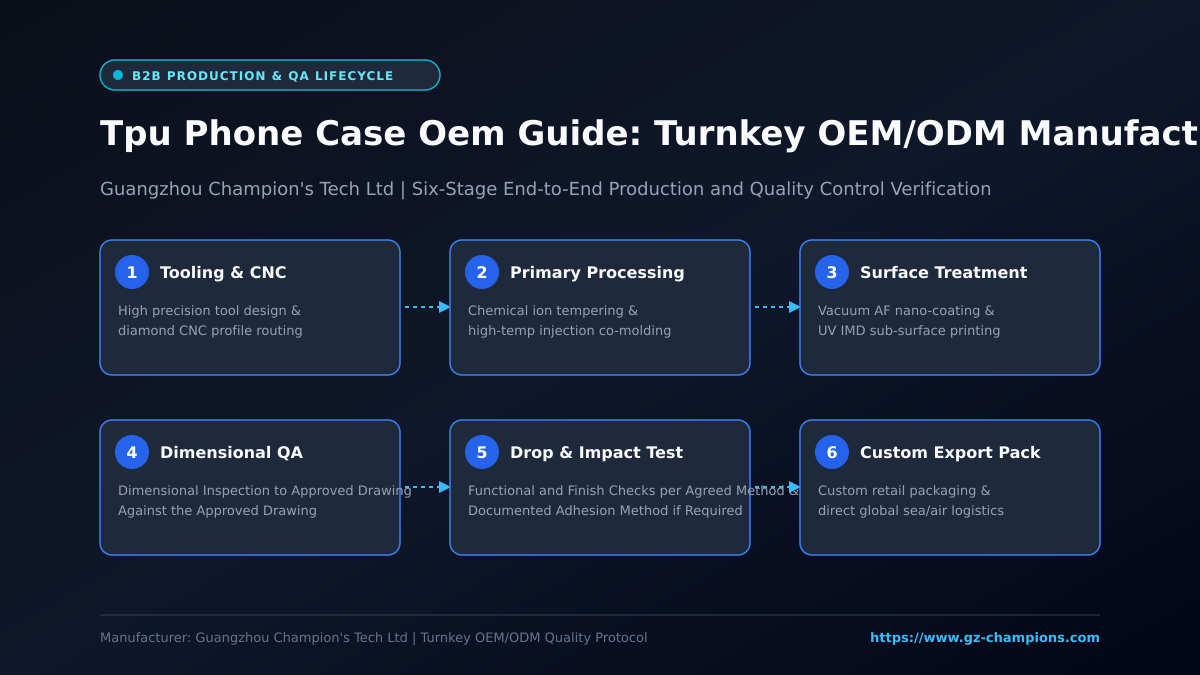
TPU injection molding is a controlled sequence: dry the pellets to the resin supplier’s instruction, melt and feed consistently, fill the cavity, cool, eject, trim and inspect. Fictiv identifies moisture preparation, venting, gate location, mold temperature, shrinkage and overmolding compatibility as design considerations. It does not provide a universal setting for every grade, so a quotation should include the proposed grade, drying condition and process window for approval.
Draft, texture and ejection
TPU can stick to a mold surface. Fictiv recommends sufficient draft, while Protolabs explains that draft reduces scraping, warping and ejection damage. Protolabs gives general starting guidance of 0.5° on vertical faces and 1–2° in many situations, with deeper cavities, texture, shrink rate and the molder’s capability changing the final requirement. Put the proposed draft on the 3D review; do not copy a single angle into every feature.
Wall transitions, gates and vents
Keep wall transitions deliberate and avoid abrupt changes that create stress or uneven cooling. Ask the toolmaker to mark gate location, weld-line risk, venting and any ribs around camera or button openings. The design review should identify cosmetic surfaces, ejector witness limits and areas where a texture or logo could increase release force. The phone case mold guide provides a complementary DFM checklist for tool ownership and sampling decisions.
4. Build an approval sample that can be measured
Approve a named sample revision, not a catalogue image. Label each sample with model, resin grade, color, tool revision and date. Use a reference phone or a controlled fixture and record fit at the camera lip, buttons, ports, corners and wireless charging area. For a clear or colored TPU, record visible flow lines, bubbles, flash, sink, gate vestige and color variation against the approved standard.
| Gate | Buyer question | Evidence to keep |
|---|---|---|
| Dimensional fit | Does the exact model seat without rocking, interference or loose corners? | Fixture/phone ID, photos and measurement record. |
| Functional access | Do buttons, camera, microphones, speakers, ports and charging accessories work? | Functional checklist with the tested accessory set. |
| Material identity | Does the lot match the approved TPU family, grade, color and hardness target? | Supplier lot, datasheet and incoming inspection record. |
| Cosmetics | Are flash, flow marks, scratches, bubbles and texture within the agreed limit? | Golden sample, defect photos and signed limit sample. |
| Decoration | Does UV print, IMD or laser marking match artwork, position and adhesion criteria? | Artwork revision, color reference and adhesion/abrasion method if required. |
| Traceability | Can every carton be linked to a PO, mold revision and inspection date? | Lot code, packing list, carton labels and inspection report. |
5. Ask for evidence without inventing a test claim
Do not convert a material property into a drop rating, waterproof promise or compliance statement. Ask the supplier to identify the test method, specimen, conditioning, number of samples and pass/fail rule for any requested claim. If no test report exists, write “not verified” in the approval record and use a narrower product description. The same rule applies to recycled content, RoHS/REACH statements, capacity, MOQ and lead time: they require current documents or a human confirmation, not a template label.
For private mold work, define who owns CAD, tool drawings, inserts and revision history. The OEM center and custom case workflow are useful starting points for a scoped inquiry, but the quotation should still list the exact model matrix and sample gate.
6. RFQ checklist for a TPU phone case OEM
- Which TPU grade and hardness range do you propose, and which resin supplier datasheet supports it?
- What drying, mold-temperature and process controls are required for that grade?
- Where are the gates, vents, weld lines and ejector marks on the proposed tool?
- What draft and texture assumptions are included in the DFM review?
- Which features are shared across models, and which require separate inserts or tools?
- How will you control color, clarity, print adhesion and lot-to-lot variation?
- What sample revision, inspection report and change-notification process will govern repeat orders?
7. Make the first order reversible
Start with a constrained model list and a documented sample approval. Keep the first production release separate from later color or artwork changes. A small, measurable pilot reveals fit and cosmetic risks before a broad launch and gives both sides a reference unit for repeat orders. When the brief is ready, send the model list, construction, decoration files and evidence requirements through the OEM/ODM inquiry route.
Source note: DataForSEO provided the keyword metrics and live SERP response for this draft (US `tpu phone case`: search volume 1,900; CPC USD 1.04; competition MEDIUM; KD was not returned). The readable technical references below were retrieved through AnySearch fallback because the DataForSEO SERP candidates had no usable bodies: Hubs TPU overview, Fictiv TPU injection molding, Protolabs draft guidance, and Shamo’s case construction example. These sources are external examples, not CHAMPIONS test records.
Request a TPU sourcing review
Share your target phone models, TPU or hybrid construction, artwork and packaging brief. CHAMPIONS can review the DFM questions and return a scoped OEM/ODM discussion without assuming unverified MOQ, capacity, certification or delivery claims.
Ready to Build Your Custom Phone Case Line?
Send your product type, target model, material, packaging request and estimated quantity. The CHAMPIONS team will review the project details and reply with the next steps.