
{
“@context”: “https://schema.org”,
“@graph”: [
{
“@type”: “Organization”,
“@id”: “https://www.gz-champions.com/#organization”,
“name”: “Guangzhou Champion’s Tech Ltd”,
“url”: “https://www.gz-champions.com/”,
“logo”: “https://www.gz-champions.com/wp-content/uploads/logo.png”,
“contactPoint”: {
“@type”: “ContactPoint”,
“contactType”: “sales”,
“email”: “karl@gz-champions.com”,
“telephone”: “+86-181-4893-3090”
}
},
{
“@type”: “BreadcrumbList”,
“@id”: “https://www.gz-champions.com/knowledge-center/sublimation-phone-case-manufacturer-guide/#breadcrumb”,
“itemListElement”: [
{
“@type”: “ListItem”,
“position”: 1,
“name”: “Home”,
“item”: “https://www.gz-champions.com/”
},
{
“@type”: “ListItem”,
“position”: 2,
“name”: “Knowledge Center”,
“item”: “https://www.gz-champions.com/knowledge-center/”
},
{
“@type”: “ListItem”,
“position”: 3,
“name”: “Sublimation Phone Case Manufacturer Guide”,
“item”: “https://www.gz-champions.com/knowledge-center/sublimation-phone-case-manufacturer-guide/”
}
]
},
{
“@type”: “WebPage”,
“@id”: “https://www.gz-champions.com/knowledge-center/sublimation-phone-case-manufacturer-guide/#webpage”,
“url”: “https://www.gz-champions.com/knowledge-center/sublimation-phone-case-manufacturer-guide/”,
“name”: “Sublimation Phone Case Manufacturer Guide: 2D Aluminum vs 3D Full-Wrap Blanks, Heat Press DFM & B2B Wholesale Sourcing”,
“description”: “Comprehensive B2B engineering guide to sublimation phone case manufacturing. Compare 2D aluminum insert blanks with 3D vacuum wrap polymers, thermal dwell curves, high-tack tape bonding, and factory defect prevention.”,
“breadcrumb”: {
“@id”: “https://www.gz-champions.com/knowledge-center/sublimation-phone-case-manufacturer-guide/#breadcrumb”
},
“isPartOf”: {
“@id”: “https://www.gz-champions.com/#website”
}
},
{
“@type”: “Article”,
“@id”: “https://www.gz-champions.com/knowledge-center/sublimation-phone-case-manufacturer-guide/#article”,
“headline”: “Sublimation Phone Case Manufacturer Guide: 2D Aluminum vs 3D Full-Wrap Blanks, Heat Press DFM & B2B Wholesale Sourcing”,
“description”: “Comprehensive B2B engineering guide to sublimation phone case manufacturing. Compare 2D aluminum insert blanks with 3D vacuum wrap polymers, thermal dwell curves, high-tack tape bonding, and factory defect prevention.”,
“mainEntityOfPage”: “https://www.gz-champions.com/knowledge-center/sublimation-phone-case-manufacturer-guide/”,
“datePublished”: “2026-10-12T09:30:00+08:00”,
“dateModified”: “2026-10-12T09:30:00+08:00”,
“author”: {
“@type”: “Organization”,
“name”: “Guangzhou Champion’s Tech Engineering Team”
},
“publisher”: {
“@id”: “https://www.gz-champions.com/#organization”
},
“image”: [
“https://www.gz-champions.com/wp-content/uploads/2026/10/2026-10-12-sublimation-phone-case-manufacturer-guide-architecture-spec.png”,
“https://www.gz-champions.com/wp-content/uploads/2026/10/2026-10-12-sublimation-phone-case-manufacturer-guide-turnkey-workflow.png”
]
}
]
}
Sublimation Phone Case Manufacturer Guide: 2D Aluminum vs 3D Full-Wrap Blanks, Heat Press DFM & B2B Wholesale Sourcing
For print-on-demand (POD) aggregators, promotional merchandise distributors, and consumer brand owners, dye sublimation remains one of the most commercially viable decoration methods for personalized smartphone covers. Unlike direct printing technologies, sublimation converts solid dye particles into vapor under calibrated thermal pressure, fusing deep within a polymer-coated matrix. This yields photographic gradient reproduction, scratch resistance, and zero surface tactile peeling. However, transitioning from low-volume desktop pressing to container-scale wholesale fulfillment introduces intricate manufacturing challenges—ranging from edge warping during thermal dwell cycles to adhesion failure in pre-applied adhesive liners.
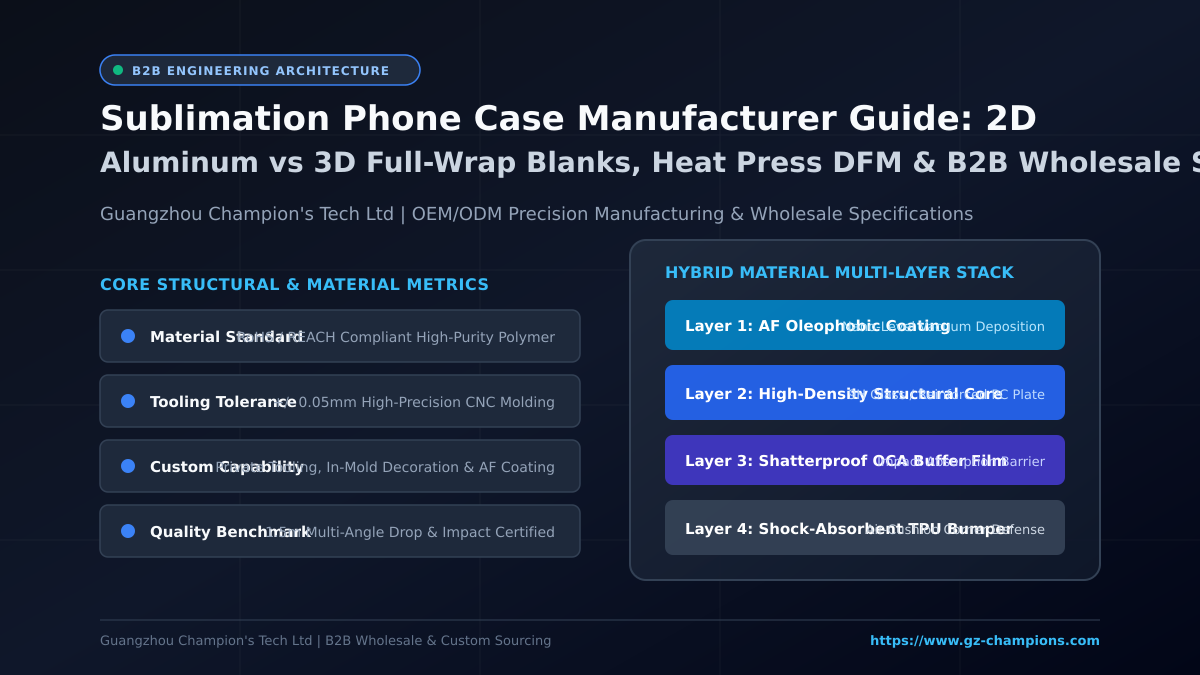
This technical sourcing guide explores the structural mechanics of sublimation phone case blanks, comparing 2D aluminum insert architectures with 3D vacuum thermoformed polymer blanks, detailing critical DFM parameters, and establishing an empirical inspection framework for B2B procurement teams evaluating OEM suppliers.
Engineering Architectures: 2D Aluminum Insert vs. 3D Full-Wrap Polymer Blanks
When sourcing sublimation blanks in bulk quantities, buyers must first decide between two fundamentally different engineering approaches: 2D hybrid insert assemblies and 3D vacuum-wrap monolithic shells.
1. 2D Hybrid Sublimation Blanks (Rubber TPU / Rigid PC Chassis + Aluminum Plate)
The 2D hybrid configuration consists of an injection-molded chassis—frequently combining a flexible shock-absorbing TPU perimeter bumper with a structural PC backplate—featuring a precision-recessed pocket on the reverse face. The printable component is an independent, high-purity aluminum alloy insert sheet (typically 0.45 mm to 0.65 mm thickness) treated on its front face with an optical-grade polyester (PET) sublimation receptive coating and backed with a high-shear double-sided adhesive strip.
- Production Workflow: The aluminum insert is printed flat using a standard commercial heat press (typically 180°C–195°C for 45–60 seconds). Once cooled, the peel-and-stick release liner is stripped, and the printed plate is permanently seated into the injection-molded phone case pocket.
- Commercial Advantages: Low equipment capital expenditure, near-zero rejection rate of the chassis during pressing, predictable color profiling, and high impact drop protection provided by the surrounding TPU bumper.
- Trade-offs: The printed artwork is restricted strictly to the flat rectangular backplate; perimeter edges and corner bumpers remain the natural resin color of the TPU case.
2. 3D Vacuum-Formed Monolithic Blanks (High-Temp Sublimation Polycarbonate)
In 3D sublimation, the phone case itself is an unibody shell injection molded from specialized high-heat-distortion Polycarbonate (PC) compounds (often modified with thermal stabilizers to withstand temperatures up to 200°C without dimensional collapse). The decoration process wraps heat-resistant transfer film around the curved side walls, top rim, and camera bezel simultaneously using pneumatic vacuum membrane presses.
- Production Workflow: The blank shell is mounted onto a precision metal cooling jig (cooling tool mandrel) to maintain internal dimensional integrity. A vacuum drawer applies uniform pneumatic draw while top and bottom heating elements heat the dye film, vaporizing pigments directly into the case substrate across 360-degree contours.
- Commercial Advantages: Complete full-wrap photographic coverage wrapping seamlessly around all lateral edges, offering premium retail aesthetics favored by high-end design houses.
- Trade-offs: Higher tooling and jig investment, stricter thermal tolerances, potential image distortion along tight radius corners, and lower shock absorption compared to dual-layer hybrid TPU construction.
Sublimation Engineering Comparison Matrix
The following technical matrix provides procurement and engineering teams with actionable baseline parameters when specifying blank chassis orders:
| Technical Parameter | 2D Aluminum Insert Architecture | 3D Full-Wrap Monolithic Shell | B2B Sourcing Consideration |
|---|---|---|---|
| Base Chassis Substrate | Dual-injection TPU bumper + PC pocket tray | High-Tg thermal-stabilized Polycarbonate (PC) | Determine drop-protection level vs aesthetic wrap requirements |
| Printable Medium | 0.45 mm–0.65 mm coated aluminum sheet (Gloss/Matte/Pearl) | Directly into resin shell via vacuum-diffused film | Check aluminum scratch resistance and peel strength |
| Press Temperature & Dwell | 180°C – 195°C (356°F – 383°F) for 45 – 60 s | 185°C – 200°C (365°F – 392°F) for 360 – 480 s | Cycle time directly dictates local fulfillment throughput |
| Tooling & Mandrel Requisites | Zero shell tooling during pressing; flat platen only | Requires model-specific aluminum cooling jigs | Tooling investment increases with new phone model releases |
| MagSafe Compatibility | Integrated N52 neodymium array embedded beneath insert pocket | Ring array embedded in internal recess via ultrasonic welding | 2D aluminum sheets must use RF-clear windowing or non-ferrous shields |
| Drop & Shock Absorption | High (MIL-STD corner air pockets molded into TPU) | Moderate (Rigid slim-fit shell absorbing primary scratch/scuff) | 2D cases dominate utilitarian protective accessory assortments |
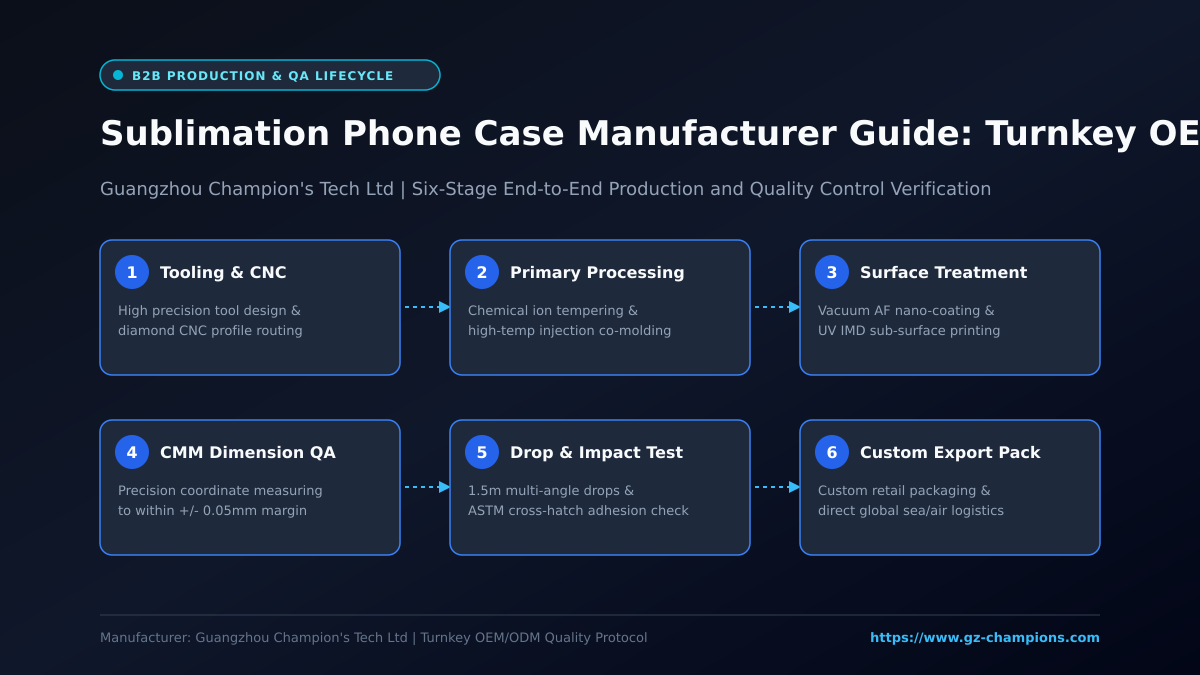
Thermal DFM & Manufacturing Defect Prevention
Mass manufacturing of sublimation phone cases demands rigorous Design for Manufacturability (DFM) control across both the injection molding plant and the downstream heat transfer operations. OEM buyers should audit the following critical quality controls:
1. Aluminum Plate Coating Homogeneity & Surface Energy
In 2D insert production, uneven thickness in the polyester spray coating results in patchy color saturation, optical mottling, or orange-peel textures under heat. High-reliability factories implement dust-free class 10,000 automated coating lines to guarantee uniform 25–35 µm dry film thickness. In addition, the aluminum substrate must be chemically degreased and passivated prior to polymer application to eliminate blister delamination when subjected to temperatures exceeding 190°C.
2. Pre-Applied Adhesive Shear Strength & Outgassing Resistance
One of the most frequent customer warranty complaints in 2D sublimation is the aluminum plate lifting along corner margins months after purchase. This failure is rarely due to mechanical shock; it is caused by solvent outgassing or sub-par pressure-sensitive adhesives (PSA). OEM specifications must mandate modified high-performance acrylic foam tape or 3M 9448A/467MP grade tissue tape. The adhesive backing must exhibit thermal stability up to 100°C to withstand battery heat emissions without polymer creep.
3. Mandrel Sizing and Anti-Warp Jig Calibration for 3D Shells
Because Polycarbonate softens near its glass transition temperature (~145°C–150°C), baking a 3D shell at 190°C inside a vacuum chamber will permanently deform the snap-fit retention lips if internal jigs are undersized. Professional OEM factories CNC-machine aluminum alloy mandrels matched precisely to CAD shrink factors (accounting for 0.5%–0.7% post-cooling shrinkage). Parts must remain clamped in cooling fixtures until part temperature drops below 50°C, ensuring snap-fit tolerances within ±0.05 mm.
4. MagSafe Magnetic Integration Without RF Interference
With magnetic wireless charging now a mandatory baseline feature, engineering sublimation blanks with embedded magnet arrays requires careful electromagnetic calibration. For 2D aluminum cases, placing an electrically conductive metal plate directly over a Qi2 or MagSafe inductive charging coil induces eddy currents that cause localized heat buildup and charging cutoff. Advanced OEM architectures solve this by utilizing precision die-cut aluminum plates featuring central circular RF windows or engineered ferrite shielding layers. For complete magnetic holding force, factories integrate 36-pole N52H neodymium magnet rings delivering >800g of vertical holding force.
B2B Procurement & Quality Inspection Checklist
When qualifying a sublimation phone case blank manufacturer or placing container-level purchase orders, technical sourcing managers should conduct strict batch verification against this inspection rubric:
- Dimensional Verification & Retention Lip Fit: Measure device snap-in grip force across corner radiuses. Bumper lip height must maintain a minimum 1.0 mm screen clearance and 0.8 mm raised camera ring protection.
- Cross-Hatch Adhesion Test (ASTM D3359): Perform lattice cross-cut testing on coated aluminum test coupons after heat pressing. Adhesion grade must achieve class 4B or 5B with zero flaking along scribe intersections.
- High-Temperature Thermal Ageing (72-Hour Test): Expose assembled cases to 65°C and 85% relative humidity for 72 continuous hours. Verify zero edge lifting, adhesive adhesive ooze, or plate warping.
- Alcohol & Sweat Rub Resistance: Conduct 200 cycles of double-rub testing using 75% isopropyl alcohol under 500g load to confirm cross-linked polyester resin integrity.
- Magnet Array Holding Force & Alignment: Test holding strength against standard MagSafe puck fixtures (specification: >= 8.0 N holding force) and verify concentric alignment with phone receiver coils.
Packaging, Private Labeling & Turnkey Sourcing Flow
Experienced B2B buyers frequently separate blank shell acquisition from regional print fulfillment to optimize inventory carrying costs and SKU responsiveness. Guangzhou Champion’s Tech supports international brands and distributors through comprehensive supply chain solutions:
- Pre-Kitted Sublimation Blank Sets: Bulk shipments packaged in custom anti-static divider cartons, featuring individually film-protected aluminum inserts and chassis trays to prevent transit abrasion.
- Private Tooling & Custom Edge Textures: Creation of exclusive private-mold TPU bumpers with branded debossed side grips, integrated lanyard anchors, and bespoke camera bezel geometries.
- Turnkey Decorating Alternatives: For brand owners seeking finished, decorated stock without investing in regional heat pressing equipment, our facility provides end-to-end production including high-resolution industrial UV printing and scratch-resistant IMD/IML manufacturing.
To request technical sample sets of 2D aluminum insert blanks, 3D vacuum shells, or custom MagSafe hybrid tooling prototypes, contact our engineering team to review 3D CAD files and quotation schedules.
Ready to Build Your Custom Phone Case Line?
Send your product type, target model, material, packaging request and estimated quantity. The CHAMPIONS team will review the project details and reply with the next steps.