
Bottom line: Sourcing from a reliable silicone phone case factory requires distinguishing between two-part Liquid Silicone Rubber (LSR) injection molding and conventional solid silicone compression tooling. For B2B procurement teams, brand owners, and electronics distributors, evaluating an OEM manufacturing partner hinges on tight tooling tolerances (±0.05 mm), cold runner precision, burr-free parting lines, and automated anti-static oil spraying. Establishing clear DFM guidelines and written quality control gates before opening private tooling prevents fit slippage, sticky dust accumulation, and costly production delays.
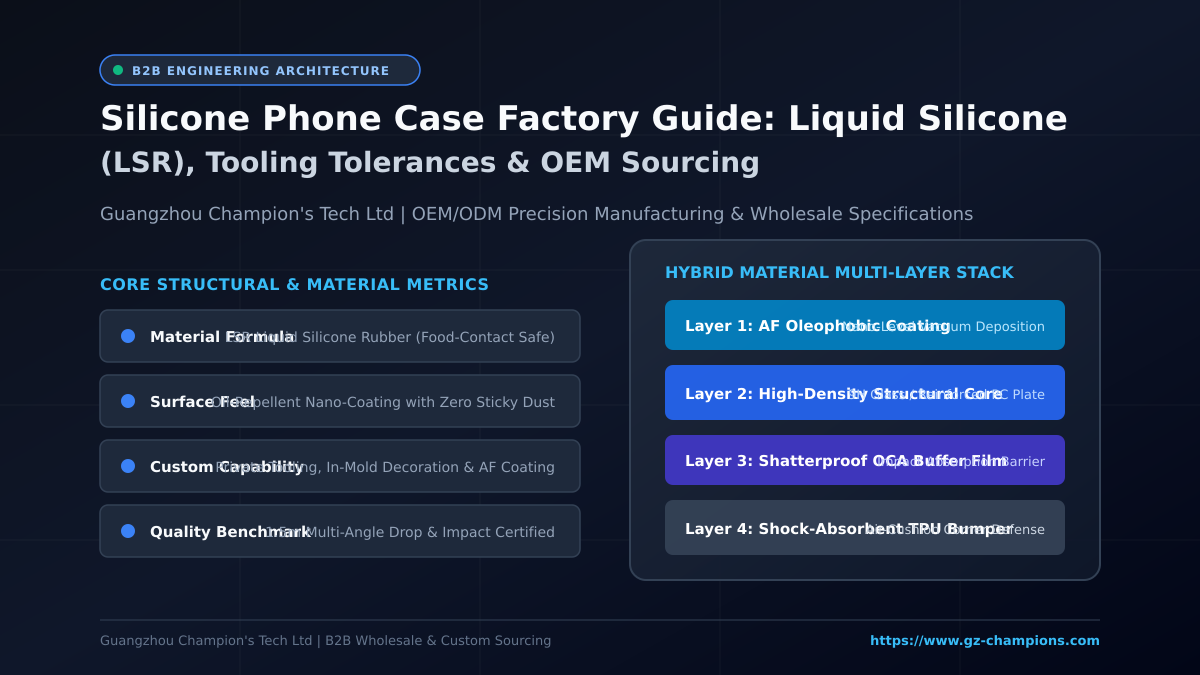
This technical guide is written for international brand owners, accessory distributors, procurement directors, and consumer electronics product managers sourcing custom protective cases. Liquid silicone continues to gain market share across premium flagship devices due to its silky tactile feel, non-slip grip, and durable elastomeric shock absorption. However, navigating the factory sourcing landscape involves substantial engineering complexity. Sourcing teams frequently confront price discrepancies of 200% to 300% between vendors because one supplier quotes automated two-shot liquid silicone injection tooling while another quotes low-cost solid compression pressing. Clarifying these material differences, tooling standards, and testing protocols is essential for protecting your brand equity and ensuring repeat batch consistency.
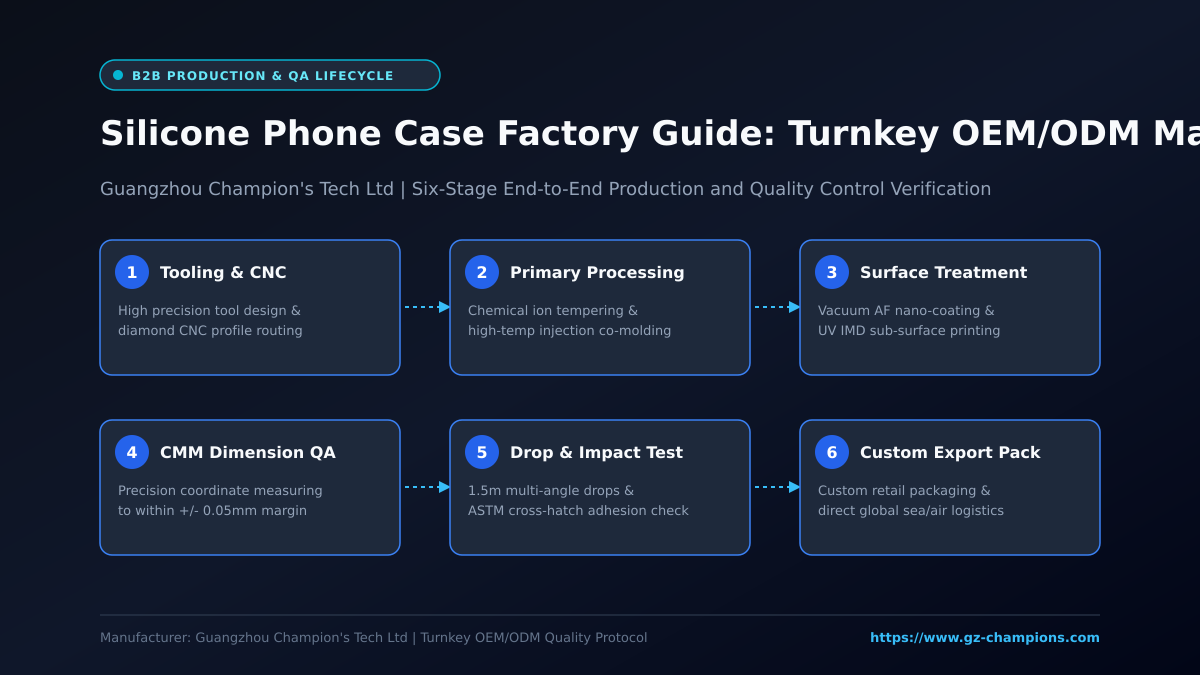
1. Core Manufacturing Technologies: Liquid Silicone Rubber (LSR) vs. Solid Compression Molding
In consumer electronics accessory manufacturing, “silicone” is not a monolithic polymer grade. As outlined in technical manufacturing documentation from custom casing supplier Qiandu Tech, industrial silicone phone covers are produced through vulcanization molding across two distinct elastomer formats: liquid silicone and solid silicone gum. Sourcing managers must understand these metallurgical and mechanical differences before committing capital to production tooling:
- Liquid Silicone Rubber (LSR) Injection Molding: LSR is a two-component platinum-cured liquid elastomer (Part A base silicone with platinum catalyst, Part B cross-linker and inhibitor). The materials are pumped through dynamic mixing blocks at an exact 1:1 volumetric ratio directly into chilled cold-runner manifolds before entering heated tool cavities (160°C to 200°C). Under heat and pressure, platinum cross-linking vulcanizes the liquid into a solid elastomer in 35 to 60 seconds. LSR molding is fully automated, produces flash-free shut-offs down to 0.03 mm, exhibits no volatile peroxide odor, and maintains high tensile elongation (up to 650%).
- Solid Silicone High-Pressure Compression Molding: Solid silicone relies on compounded high-consistency rubber (HCR) gum mixed with pigments and vulcanizing agents on open two-roll mills. Operators weigh and place pre-cut silicone strips manually into heated cavity plates. A high-tonnage hydraulic press clamps the tool closed, forcing the dense rubber to flow into perimeter ribs. Compression molding involves longer cycle times (120 to 240 seconds per cycle) and leaves noticeable flash along parting lines that requires manual trimming. Tolerances are wider (±0.15 mm), making compression molding better suited for budget-conscious entry models or looser standalone accessories.
2. Multi-Layer Engineering: Three-Tier Composite Architecture
High-end OEM protective cases rarely consist of a single unreinforced silicone skin. Because pure silicone has high elasticity and low flexural modulus, an unreinforced single-layer silicone case easily stretches and detaches from phone corners during pocket extraction or drop impacts. To achieve the rigid structural integrity demanded by premium brands, professional factories employ a three-tier hybrid composite architecture:
- Internal Microfiber Textile Inlay: The interior chassis is lined with a precision-die-cut 0.3 to 0.5 mm microfiber or velvet fabric. This layer cushions the smartphone back glass against cosmetic scratches caused by trapped environmental dust particles. The adhesive bonding must be thermally rated to withstand continuous 65°C operational temperatures during rapid wireless charging without edge peeling.
- Rigid Polycarbonate (PC) Structural Core: A molded 0.8 to 1.1 mm structural polycarbonate skeleton serves as the rigid internal skeleton. This PC sub-frame defines the dimensional geometry, locks in tactile button apertures, and ensures snug corner retention. Before overmolding, the PC frame undergoes automated surface plasma treatment or silane primer application to establish molecular covalent bonding with the exterior silicone layer.
- Outer Tactile Silicone Cushion: The outer protective layer consists of 1.2 to 1.6 mm of high-tear liquid silicone rubber. It provides 360-degree corner impact absorption, ergonomic grip, and raised perimeter bezels (0.8 to 1.2 mm above the display screen and camera housing) to shield optics from flat-surface impacts.
To evaluate how composite constructions compare with other protective architectures, explore our Hybrid Phone Case Manufacturer Guide and TPU vs Silicone Phone Case Guide.
3. Tooling Design, Runner Systems, and Precision Tolerances
Polymer engineering analyses published by hardware manufacturing platforms like The Studio emphasize that device schematics, load zones, and tooling oversight must be validated before cutting steel. Sourcing from a silicone phone case factory requires deep auditing of the supplier’s mold manufacturing capabilities. Silicone rubber has extremely low viscosity during initial injection flow, meaning it can easily seep into parting clearances as small as 5 to 8 microns (0.005–0.008 mm), resulting in severe flash.
Key tooling specifications to mandate during DFM (Design for Manufacturability) review include:
- Mold Steel Grade: Tooling must use vacuum-degassed corrosion-resistant stainless steels such as Stavax ESR, NAK80, or 420SS hardened to 48–52 HRC. Because silicone releases micro-acidic volatiles during hot vulcanization, standard carbon steel tools will pit, corrode, and lose optical surface finish within 15,000 cycles.
- Cold Runner Valve-Gate Technology: Premium LSR molds integrate chilled cold-runner manifolds equipped with pneumatic needle valve gates. Chilling the runner to 20°C–25°C keeps the silicone liquid until it passes through the gate orifice into the 180°C cavity plate. This eliminates cold-slug blemishes, minimizes polymer waste, and hides gate vestiges beneath internal microfiber inlays.
- Shrinkage Compensation Calculations: Silicone rubber exhibits substantial thermal contraction upon cooling, with volumetric shrinkage typically between 2.0% and 3.2% depending on durometer and pigment loading. The factory CAD engineering team must apply precise non-linear shrinkage compensation across XYZ axes during CNC electrode cutting to ensure the final molded shell matches official OEM CAD release dimensions.
For more technical details on mold manufacturing workflows, review our Phone Case Mold Manufacturer Guide.
4. Technical Comparison: LSR vs. Solid Silicone Manufacturing Parameters
The table below provides a side-by-side engineering comparison between Liquid Silicone Rubber (LSR) injection molding and Solid Silicone compression molding to assist procurement managers in optimizing budget, volume, and quality criteria:
| Engineering Parameter | Liquid Silicone Rubber (LSR) Injection | Solid Silicone Compression Molding | Procurement Evaluation Criterion |
|---|---|---|---|
| Raw Material Format | Two-part liquid (1:1 ratio, A+B component platinum-cure) | Solid gum slab mixed with pigments and vulcanizing agent | Verify automated closed-loop metering vs. manual weighing |
| Cycle Time (per shot) | 35 – 65 seconds | 120 – 240 seconds | Directly governs daily factory throughput and peak delivery speed |
| Parting Line Flash | ≤ 0.03 mm (precision automated shut-off) | 0.10 – 0.35 mm (requires manual blade deburring) | Inspect tactile seam across ergonomic finger-contact areas |
| Dimensional Tolerance | ±0.05 mm (critical-to-quality snap fit) | ±0.15 mm (moderate variance across batches) | Ensure precise camera cutout alignment and port access |
| Tensile Strength & Elongation | Tensile > 8.5 MPa; elongation 450% – 650% | Tensile > 5.5 MPa; elongation 300% – 450% | Determines grip retention and long-term resistance to stretching loose |
| Initial Tooling Investment | Higher ($4,500 – $8,500 per multi-cavity tool) | Lower ($1,800 – $3,200 per tool) | Evaluate against total planned production volume and unit amortization |
| MagSafe Magnetic Array Integration | Automated in-mold magnetic module insertion | Manual positioning into pre-pressed cavity nests | Verify magnet retention force (≥ 800g) and magnetic flux centering |
| Surface Feel & Dust Resistance | Requires cleanroom anti-static soft-touch oil spray | Requires secondary anti-static oil coating | Test lint attraction and 1,000-cycle alcohol rub resistance |
5. Surface Finishing: Overcoming the “Sticky Dust” Vulnerability
One of the primary historical drawbacks of raw silicone cases is electrostatic lint and dust attraction. Uncoated silicone possesses high surface friction and electrostatic triboelectric charging, causing it to attract pocket lint, pet hair, and airborne particulate matter immediately upon handling.
A professional OEM silicone phone case factory eliminates this problem through a tightly controlled secondary finishing process:
- Enclosed Cleanroom Anti-Static Oil Spraying: After molding, parts enter a positive-pressure Class 10,000 cleanroom spraying workshop. Multi-axis automated robotic sprayers apply an ultra-thin (5 to 8 micron) coating of silicone-modified polyurethane anti-static feel oil. This oil lowers the surface coefficient of friction while neutralizing static charge generation.
- Continuous Thermal Curing Tunnel: Coated cases pass through an automated infrared and ultraviolet curing oven at 120°C for 20 minutes. This completes polymer cross-linking, transforming the coating into an oil-resistant, hydrophobic skin that feels silky to the touch and allows dust to be wiped away effortlessly with a damp cloth.
- Secondary Post-Curing Baking: High-tier factories place molded silicone cases in industrial convection ovens at 150°C for 2 hours. This secondary vulcanization process drives off residual volatile cyclic siloxanes, completely eliminating chemical odors and guaranteeing compliance with international consumer health directives.
6. 5-Point Quality Control (QC) Inspection Checklist for Sourcing Teams
Before releasing final balance payments or authorizing ocean container shipments, buyers should insist on documented inspection reports verifying the following 5 quality gates:
- Dimensional Tolerance & Snap-Fit Engagement: Verify critical dimensions against 2D engineering drawings using an automated optical coordinate measuring machine (CMM). Install samples on actual smartphone master jigs: the case perimeter must engage snugly with uniform retention tension, and camera cutouts must maintain a consistent 0.8 to 1.2 mm clearance without edge vignetting.
- Shore A Hardness Verification: Inspect silicone material durometer using a calibrated ASTM D2240 durometer gauge. Standard liquid silicone covers should measure between 45A and 55A for comfortable shock-absorbing hand feel, while internal PC structural frames must test at Rockwell R115 minimum.
- Microfiber Lining 90-Degree Peel Test: Using a digital tensile test stand (ASTM D6862), test microfiber adhesion against the internal PC shell. The adhesive bond must exceed the tensile tear strength of the microfiber fabric itself, ensuring zero edge delamination during prolonged consumer use.
- Surface Coating Rub & Abrasion Resistance: Subject the exterior soft-touch coating to an automated alcohol rub test (500g downward load, 99.5% isopropyl alcohol, 200 double strokes) and an RCA paper tape abrasion test (150 cycles). The coating must show no substrate exposure, gloss discoloration, or stickiness.
- Environmental Compliance & VOC Testing: Confirm that the silicone compound, internal bonding adhesives, and surface feel oils are certified free of restricted heavy metals, phthalates, and SVHCs in compliance with EU RoHS 2.0 (Directive 2011/65/EU) and REACH (EC 1907/2006).
For broader procurement inspection frameworks, consult our Custom Phone Case Manufacturer Guide and Shockproof Phone Case Manufacturer Guide.
7. Factory Audit Checklist: Questions to Ask Before Issuing an RFQ
When interviewing potential manufacturing partners in China or Southeast Asia, use these targeted technical questions to distinguish genuine direct manufacturers from trading intermediaries:
- Do you operate an in-house LSR injection molding workshop with automated cold-runner dosing equipment, or do you subcontract silicone pressing to third-party compression vendors?
- What mold steel grade is specified in the tooling contract (e.g., Stavax ESR vs. P20), and what is the guaranteed tool life in shot cycles?
- Do you perform secondary post-curing baking in convection ovens to eliminate volatile siloxanes and residual odor?
- What is your cleanroom classification for anti-static feel oil spraying, and how do you verify coating thickness and alcohol rub durability?
- How do you handle MagSafe magnetic ring integration to prevent magnet debonding or interference with 15W wireless charging protocols?
8. Partner with Guangzhou Champion’s Tech for Custom Silicone Tooling
At Guangzhou Champion’s Tech Ltd, our manufacturing facility provides end-to-end OEM and ODM support for global smartphone accessory brands, retail distributors, and corporate merchandise clients. From high-precision multi-cavity liquid silicone (LSR) injection mold engineering to precision PC skeleton insert molding, automated anti-static spraying, and turnkey MagSafe integration, we transform your industrial product designs into market-ready retail products.
Explore our comprehensive OEM/ODM production capabilities, examine our specialized custom manufacturing services, or browse the technical resources available in our Knowledge Center. Contact our engineering team today with your 3D STEP files or product concept to receive a complete DFM feasibility assessment, mold cavitation layout, and transparent tooling quotation.
Ready to Build Your Custom Phone Case Line?
Send your product type, target model, material, packaging request and estimated quantity. The CHAMPIONS team will review the project details and reply with the next steps.