
Waterproof and submersible protective smartphone cases represent one of the most mechanically demanding segments in mobile accessory manufacturing. While modern flagship devices feature factory ingress protection (such as IP68 ratings for fresh water), brand owners, industrial clients, outdoor lifestyle labels, and enterprise equipment distributors recognize that bare device ingress protection degrades quickly with chassis drops, microscopic frame bending, and exposure to chlorinated or saline water. Sourcing a dedicated full-enclosure waterproof phone case requires rigorous engineering evaluation of dual-shot injection molding, Liquid Silicone Rubber (LSR) elastomeric gaskets, hydrophobic and oleophobic acoustic membranes, and 100% production-line air pressure decay testing.
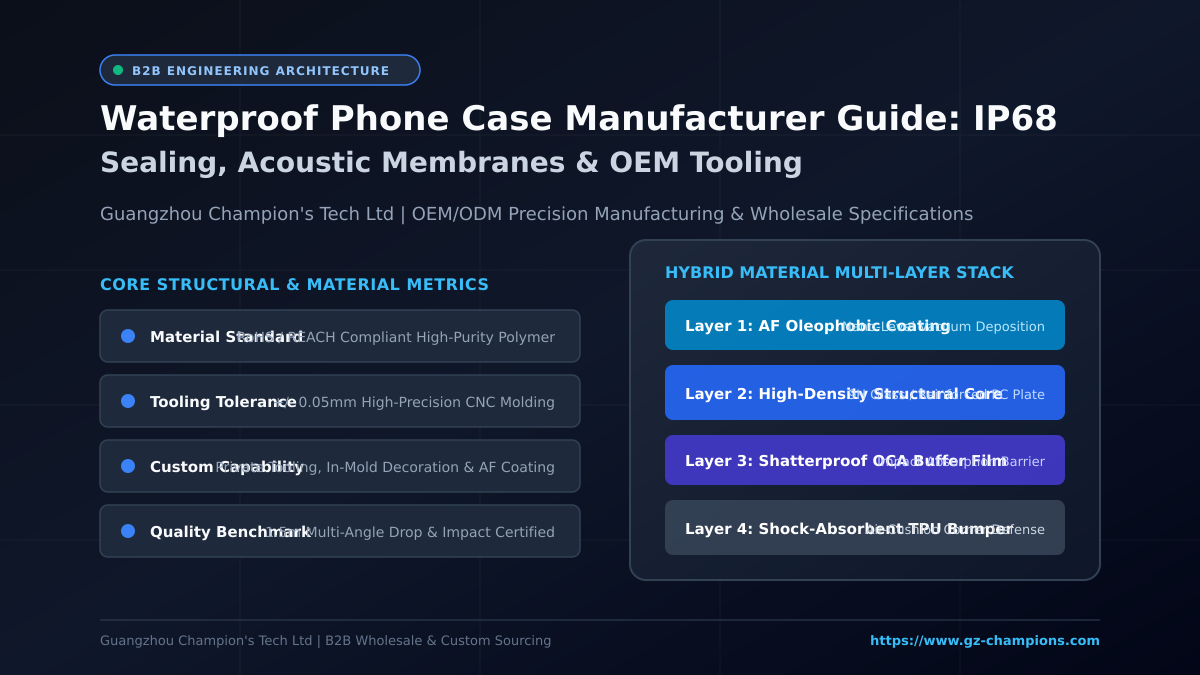
This technical sourcing guide explores the structural architecture, mold engineering tolerances, material compatibility, and quality assurance workflows required to manufacture heavy-duty, IP68-compliant waterproof phone cases. Whether sourcing private mold tooling or establishing OEM turnkey programs, procurement teams will gain the quantitative benchmarks necessary to prevent field leakage and maintain high customer satisfaction.
Ingress Protection Ratings: Deconstructing IP67 vs. IP68 for Mobile Enclosures
The International Electrotechnical Commission (IEC) standard 60529 outlines Ingress Protection (IP) ratings for electronic enclosures. For consumer smartphone accessories, the standard establishes exact environmental protection boundaries:
- First Digit (Solids & Dust Ingress): A rating of ‘6’ represents complete protection against dust contact and airborne particulate penetration over continuous vacuum testing (dust-tight).
- Second Digit (Liquid Ingress – Level 7): IPX7 signifies protection against water penetration during temporary submersion up to 1.0 meter depth for 30 minutes under static hydrostatic pressure.
- Second Digit (Liquid Ingress – Level 8): IPX8 specifies continuous submersion under conditions defined and agreed upon by the manufacturer and buyer, typically exceeding 2.0 meters to 3.0 meters for 60 to 120 minutes.
In B2B contract manufacturing, achieving an authentic IP68 rating requires continuous structural clamp compression across 360 degrees of the case perimeter. Any microscopic distortion along parting lines or corner snap tabs under hydrostatic load leads to seal displacement and catastrophic device failure.
Structural Sealing Architectures: Co-Molding vs. Discrete Compression Gaskets
OEM factories employ two primary structural philosophies when engineering waterproof cases. The choice of architecture directly dictates tooling amortization, cycle times, unit costs, and field reliability.
1. Liquid Silicone Rubber (LSR) Multi-Shot Overmolding
In high-volume automated production, dual-shot (2K) injection presses mold a rigid Polycarbonate (PC) or Glass-Fiber reinforced Polyamide (PA) skeleton, followed immediately by secondary injection of Liquid Silicone Rubber (Shore 40A to 50A). The LSR forms a chemical and mechanical bond directly with the PC substrate. This eliminates manual gasket placement during assembly, guarantees absolute dimensional alignment, and prevents gasket rolling or detachment during consumer installation.
2. Molded Compression O-Ring Channels
In modular two-piece snap-fit designs, a continuous perimeter groove is CNC-machined into the front or rear case bezel. A precision vulcanized fluorosilicone or EPDM gasket with a rectangular or multi-lip profile is seated into the channel. When the polycarbonate front bezel snaps into the rear frame via high-stiffness undercut hooks, the gasket is subjected to controlled 25% to 30% compression displacement, forming a hermetic liquid barrier.
Engineering Material & Tooling Parameter Comparison
Balancing impact durability, optical clarity for touchscreen interaction, acoustic transmission, and dimensional stability requires careful substrate selection. The table below compares the primary engineering materials used across critical waterproof case subcomponents:
| Component | Primary Material Substrate | Mechanical & Environmental Property | Tooling & Dimensional Tolerance |
|---|---|---|---|
| Rigid Outer Shell | Bayer/Covestro High-Impact Polycarbonate (PC) | Tensile yield >= 65 MPa; zero water absorption; high dimensional stiffness | +/- 0.05 mm precision tooling; polished SPI A-2 finish |
| Perimeter Sealing Gasket | Medical-Grade Liquid Silicone Rubber (LSR) | Shore A 45 +/- 5; compression set < 15% (22h @ 70 C); UV & ozone inert | 2K tooling injection gate balance; flash tolerance < 0.02 mm |
| Touchscreen Membrane | Optical-Grade PET / High-Transmittance Polycarbonate | 92% optical clarity; 3H pencil scratch hardness; responsive capacitive touch | Thermoformed 3D curvature +/- 0.08 mm; hydrophobic surface coating |
| Acoustic Vents | Expanded Polytetrafluoroethylene (ePTFE) | Hydrophobic/Oleophobic (WEP > 100 kPa); acoustic insertion loss < 2.5 dB | Precision rotary die-cut rings; adhesive thermal tacking |
| Corner Bumpers | Shock-Absorbing Thermoplastic Polyurethane (TPU) | Shore 85A; dynamic rebound resilience; drop impact deceleration | Co-injected perimeter overmold; peel adhesion > 5.0 N/mm |
| Camera Lens Window | Chemically Strengthened Optical Glass / Optical PC | 9H surface hardness; anti-reflective (AR) & anti-fingerprint (AF) coatings | Hermetic ultrasonic or UV adhesive bonding; zero optical distortion |
Acoustic & Barometric Engineering: Resolving Audio Attenuation and Pressure Build-up
The most persistent engineering challenge in fully sealed waterproof phone cases is audio degradation. Enclosing the microphone, receiver, and speaker ports behind solid barriers dampens sound waves, resulting in muffled call quality, echo cancellation feedback, and distorted audio playback.
To overcome acoustic damping while maintaining IP68 hermeticity, Champion’s utilizes micro-porous expanded Polytetrafluoroethylene (ePTFE) acoustic venting membranes:
- Sub-Micron Pore Geometry: The microscopic pore structure of ePTFE membranes (0.2 to 1.0 micrometer pore diameter) is thousands of times smaller than water droplets, providing extreme Water Entry Pressure (WEP) resistance exceeding 100 kPa (equivalent to 10 meters of water column).
- Air & Sound Permeability: The low mass and high flexibility of the microporous matrix allow audio acoustic waves to oscillate freely across the membrane, reducing total acoustic insertion loss to less than 2.0 to 3.0 dB across standard telecommunication frequencies (300 Hz to 4 kHz).
- Oleophobic & Salt-Fog Protection: Specialized fluoropolymer surface treatments prevent surfactant liquids, body sweat oils, sunscreen lotions, and salt crystals from wetting or clogging the membrane pores, preserving sound clarity in coastal and humid marine environments.
- Internal Barometric Equalization: Altitude changes (such as commercial air flight) or thermal expansion caused by continuous device processor load create internal case pressure deltas. The ePTFE membrane permits continuous micro-venting air equalization, preventing the touchscreen membrane from ballooning or inward collapsing.
MagSafe Magnetic Array Integration into Hermetic Housings
With wireless magnetic charging standard across modern flagship smartphones, integrating magnetic mounting arrays into waterproof cases requires specialized DFM considerations. Embedding sintered Neodymium (NdFeB) magnets within a sealed casing presents two critical engineering hazards: magnetic flux attenuation through thick waterproof walls and corrosive oxidation if moisture bypasses outer skins.
Champion’s resolves these challenges through an engineered recessed magnetic ring architecture:
- Nickel-Copper-Nickel Triple Plating: All sintered N52 or N52SH NdFeB magnets undergo electroplated Ni-Cu-Ni plus supplementary epoxy sealing to survive severe 96-hour ASTM B117 salt spray exposure without surface rust.
- Magnetic Permeability & Wall Calibration: The rear polycarbonate wall thickness directly overlying the magnet array is precision-machined to 0.70 mm +/- 0.05 mm, minimizing magnetic air gaps to maintain over 900 to 1,200 gf magnetic holding force on automobile mounts and MagSafe chargers.
- Backplane Flux Concentrator: A 0.20 mm stamped silicon-steel or permalloy ring is positioned behind the magnet array. This redirects stray magnetic flux lines outward toward the accessory while shielding the internal battery, preventing induction overheating during 15W Qi/Qi2 wireless charging.
Turnkey B2B Manufacturing & Mold Development Workflow
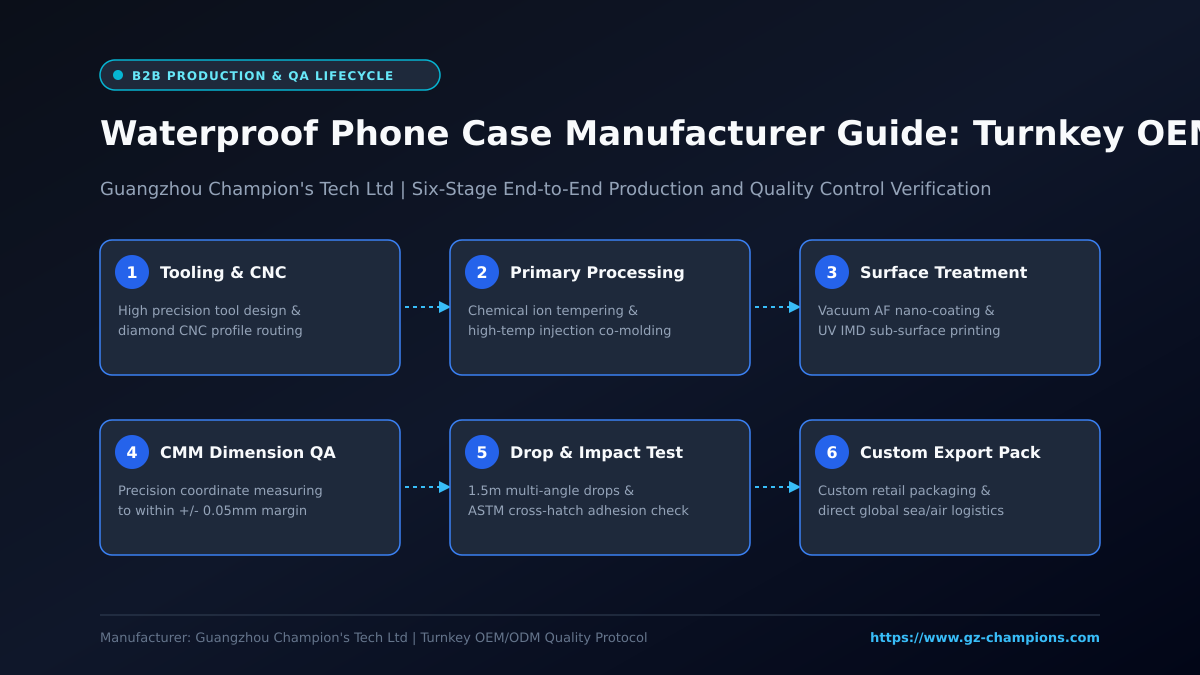
Executing an OEM/ODM waterproof smartphone case project from initial industrial CAD design through mass delivery requires a structured, milestone-driven gate process:
- DFM & Sealing Feasibility Review: Analysis of parting lines, draft angles (minimum 1.5 degrees on sealing ribs), gate locations, snap-tab engagement geometry, and material shrinkage compensation.
- High-Precision Mold Tooling: High-speed CNC machining and mirror EDM tooling using hardened Swedish Stavax ESR or NAK80 tool steels (HRC 48-52) to guarantee sealing lip smoothness and long tool life.
- T0 / T1 Prototyping & Dimensional CMM: Initial shot injection to verify mold filling balance, shrinkage rates, optical lens flatness, and automated coordinate measuring machine (CMM) verification against CAD.
- Dry & Wet Leakage Test Calibration: Subjecting initial samples to calibrated air pressure decay chambers and pressurized hydrostatic tanks to dial in seal compression parameters.
- Membrane & Optical Film Die-Cut Lamination: Automated cleanroom adhesive dispensing and ultrasonic welding of ePTFE acoustic membranes and optical lens elements.
- Pilot Production Run: Running 1,000 to 3,000 units on automated injection lines to establish process capability indices (Cpk >= 1.33) across perimeter dimensions.
- Mass Production & 100% Inline Testing: High-speed injection, dual-shot overmolding, laser etching, automated assembly, and robotic air-decay pressure testing.
- B2B Packaging & Shipment: Assembly into customized retail gift boxes or bulk protective blister cartons, accompanied by desiccant packs, user installation guides, and water-test test strips.
Factory Quality Control: 8-Point Inspection Protocol
Waterproof cases carry strict liability risks for brand owners. Sourcing teams must demand rigorous, multi-tiered quality control protocols at the factory floor before release of mass shipments:
- 100% Inline Air Pressure Decay Leak Testing: Every individual assembled case undergoes automated dry air pressure decay testing in custom pneumatic jigs. The unit is pressurized to 25–30 kPa; an acoustic/pressure differential sensor monitors pressure drop over 15 seconds. Any decay exceeding 0.05 kPa rejects the unit automatically.
- Statistical Hydrostatic Submersion Tank Testing: Batch samples (AQL 0.65 Level II) are submerged in an automated pressure tank at 2.0 to 3.0 meters equivalent hydrostatic head (0.2 to 0.3 bar) for 60 minutes. The internal chamber contains moisture-indicating paper strips that change color upon contact with liquid water.
- MIL-STD-810H Drop Impact Durability: Assembled units containing metal dummy test phones survive 26 drops from 1.5 meters (5 feet) onto smooth concrete over plywood backing across all faces, edges, and corners without latch opening, seal displacement, or structural cracking.
- Thermal Shock & Seal Fatigue Cycling: Environmental chamber cycling between -20 C and +65 C at 90% RH across 48 continuous cycles. Gasket elasticity and snap-tab retention force must show zero degradation after temperature normalization.
- Acoustic Decibel Loss & Distortion Testing: Audio frequency sweep (100 Hz – 8 kHz) measured inside an anechoic sound box using artificial ear/mouth simulator equipment (ITU-T P.57) to ensure acoustic attenuation remains under 3.0 dB.
- Touchscreen Sensitivity & Optical Haze Inspection: Spectrophotometer testing of the front membrane ensuring >= 90% light transmittance and < 2% optical haze, coupled with capacitive stylus multi-touch testing across peripheral screen bezels.
- Chemical, Perspiration & Salt Fog Exposure: 48-hour ASTM B117 neutral salt spray test to verify zero corrosion on port latch pins, hinge springs, and MagSafe magnet arrays, combined with artificial sweat and sunscreen chemical swab testing.
- Latch & Port Cover Cycling Test: Automated pneumatic actuators open and close charging port silicone plugs and audio latches for 1,000 continuous cycles to confirm zero tear, deformation, or sealing degradation.
Frequently Asked Questions (FAQ) for B2B Procurement Teams
What is the difference between air decay testing and water immersion testing during mass production?
Air pressure decay testing is a clean, non-destructive, high-speed automated method that detects microscopic air leak paths (which are smaller than water molecules) in seconds. Performing air decay on 100% of finished cases ensures every shipped unit is sealed. Hydrostatic water immersion is a destructive/wet statistical batch test used to validate design limits and confirm physical performance under real submersion conditions.
Can custom waterproof cases accommodate camera action buttons and capacitive side sensors?
Yes. Modern waterproof tooling incorporates flexible Liquid Silicone Rubber (LSR) button membranes and capacitive conductive silicone inserts molded directly over side button apertures. This provides tactile mechanical feedback and capacitive finger detection without compromising the IP68 liquid barrier.
How does Guangzhou Champion’s Tech support private mold development for new device releases?
Champion’s provides complete in-house DFM engineering, CNC mold tooling, and rapid 3D SLA/SLS functional prototyping. When upcoming smartphone models are scheduled for release, our engineering team utilizes high-precision 3D dimensional CAD data to engineer tooling ahead of market launch, allowing distributors and retail brands to ship certified waterproof accessories simultaneously with device availability.
Initiate Your OEM Waterproof Phone Case Project
Whether manufacturing heavy-duty IP68 outdoor rugged cases, marine lifestyle covers, or industrial enterprise field housings, Guangzhou Champion’s Tech Ltd provides turnkey tooling engineering, certified acoustic membrane integration, and automated 100% leak testing. Discover our full scope of OEM/ODM manufacturing services, explore our precision customization capabilities, evaluate our shockproof phone case engineering guide, or consult our technical library in the Knowledge Center for turnkey B2B sourcing insights.
Ready to Build Your Custom Phone Case Line?
Send your product type, target model, material, packaging request and estimated quantity. The CHAMPIONS team will review the project details and reply with the next steps.