
For international electronics accessories brands, enterprise corporate gift procurement teams, and consumer goods distributors, sourcing high-end leather protective cases involves far more than picking pleasant grain patterns. Engineering a commercial leather smartphone case demands precision skiving, thermoset structural bonding, edge oil burnishing, and magnetic array shielding across complex compound geometries.
As flagship devices evolve with sensitive inductive charging coils, tactile capacitive buttons, and massive camera islands, leather case manufacturing has transformed from traditional leathercraft into a high-precision composite assembly discipline. This engineering guide examines the complete OEM/ODM production lifecycle of leather phone cases, compares synthetic versus authentic leather substrates, outlines critical edge-sealing and adhesive chemistries, and delivers an exhaustive evaluation framework for B2B procurement professionals.
Substrate Metallurgy & Polymer Anatomy: Genuine vs. Synthetic Leathers
A successful leather case begins with choosing an exterior covering matched to your brand positioning, compliance demands, and unit budget thresholds. B2B manufacturers balance tactile feel, abrasion endurance, and thermal formability across four primary material classifications:
1. Top-Grain & Full-Grain Bovine Leather
Authentic bovine hide represents the luxury benchmark for premium retail accessories. Full-grain leather preserves the complete natural epidermis, developing an authentic patina as oils from handling interact with the surface over time. However, natural hides introduce organic gauge variations (0.8 mm to 1.4 mm) and surface scars that require optical grading and computerized CNC oscillating knife sorting to maintain uniform panel consistency across mass production.
2. Polyurethane (PU) Microfiber Leather
High-grade microfiber synthetic leather has emerged as the preferred vegan alternative for international retail brands. Engineered with a three-dimensional cross-linked polyamide microfiber matrix coated with aqueous polyurethane resin, premium PU microfiber replicates the tensile tear resistance and breathability of authentic hide while delivering complete chemical uniformity, zero surface flaws, and strict weight tolerances (0.5 mm to 0.7 mm).
3. Recycled Bonded Leather (Salpa)
Constructed by pulverizing vegetable-tanned leather scraps combined with natural latex binders, bonded leather offers a circular economy narrative. While delivering authentic leather scent and moderate flex endurance, bonded substrates possess lower tensile yield strength, requiring secondary polymer reinforcement backings when wrapped around tight smartphone corner radiuses.
4. Bio-Based & Plant-Derived Synthetics
Emerging formulations derived from apple pomace, cactus fiber, or mushroom mycelium combined with bio-polyurethane binders serve niche eco-conscious markets. Similar to our developments in eco-friendly phone case manufacturing, these substrates require tailored hot-melt adhesive profiles to avoid thermal degradation during thermo-compression wrapping.
Cross-Sectional Architecture of an OEM Leather Phone Case
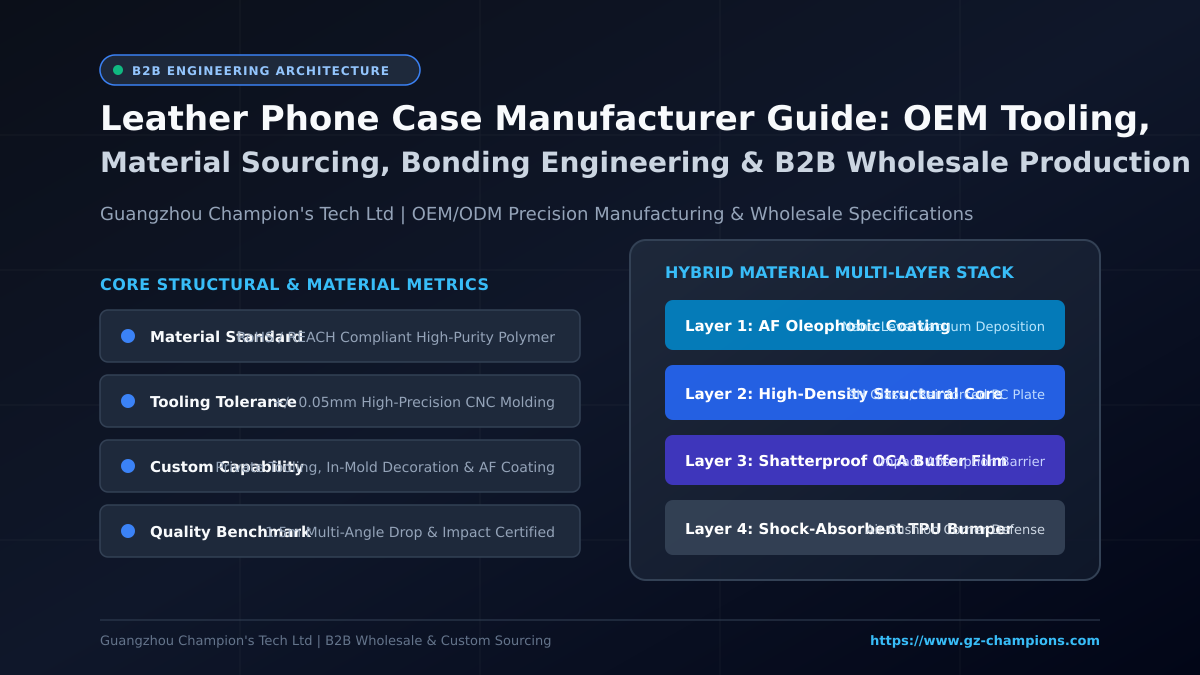
A premium leather smartphone case is a sophisticated multi-ply laminate designed to absorb mechanical shocks while maintaining a slim tactile profile. The cross-section typically integrates four distinct functional tiers:
- Outer Decorative Layer (0.50 mm – 0.80 mm): Precision-skived genuine bovine leather or aqueous PU microfiber treated with hydrophobic stain guards and UV stabilization additives.
- Internal Structural Chassis (0.80 mm – 1.20 mm): Injection-molded virgin Polycarbonate (PC) or Glass-Fiber Reinforced PC (GF-PC) skeleton providing torsional rigidity, corner impact resistance, and dimensionally stable retention lips. For dual-layer shock protection, an overmolded TPU bumper perimeter is frequently combined, as explored in our hybrid phone case manufacturer guide.
- Magnetic Flux Shunting Module (0.35 mm – 0.45 mm): Sintered N52 neodymium magnet ring array paired with a 0.15 mm Mu-Metal or high-permeability silicon steel back-plate shield, ensuring robust accessory attachment without distorting internal smartphone inductive sensors or compass ICs, following standards detailed in our custom MagSafe case manufacturer guide.
- Microfiber Inner Lining (0.30 mm – 0.50 mm): Ultra-soft Japanese microfiber or velour flocking laminated with solvent-free hot melt film, cushioning the smartphone back glass against micro-abrasions and trapped ambient grit.
The 6-Phase Turnkey Leather Case Manufacturing Process
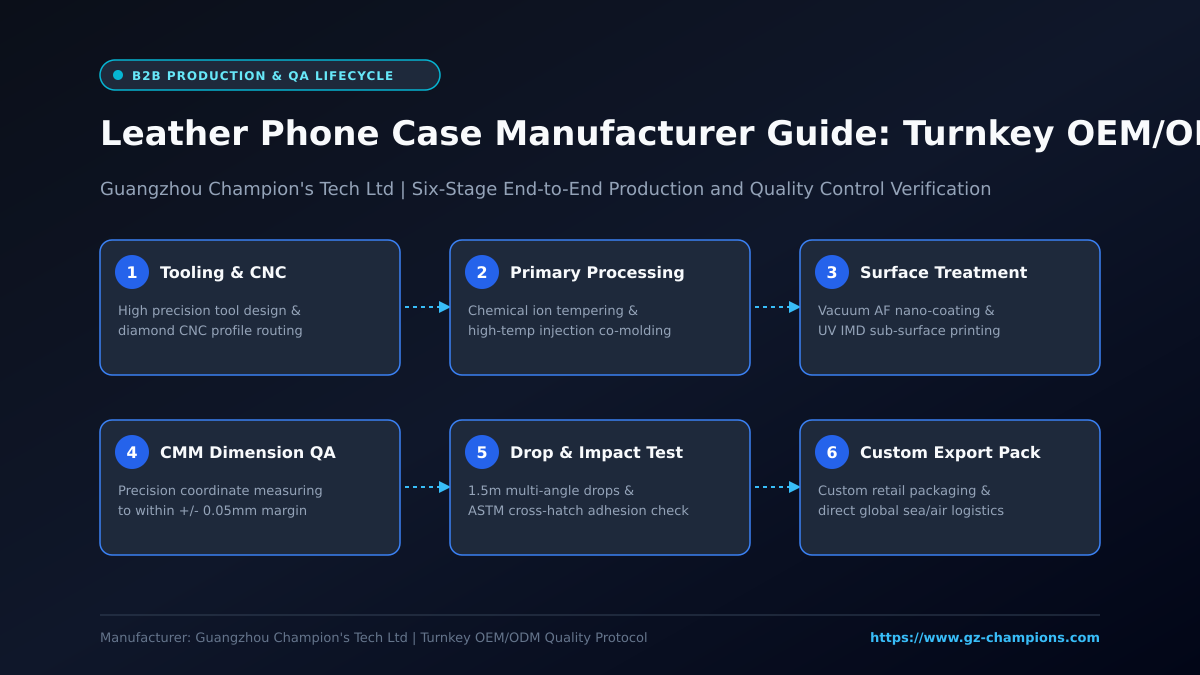
Mass-producing leather smartphone cases with zero delamination and crisp seam tolerances requires a disciplined multi-stage factory workflow:
Phase 1: Computerized Die Cutting & Precision Edge Skiving
Continuous leather hides or roll-stock microfiber are flattened and mapped. Automated CNC vibrating blade cutters or high-tonnage hydraulic clicker presses cut perimeter blanks and camera apertures. Blanks then pass through automated rotary skiving machines, feathering perimeter edges down from 0.80 mm to an exact bevel of 0.25 mm. Feathered skiving ensures that folded corners remain flush without creating bulky, uneven bumps.
Phase 2: Injection Molding of the Rigid Structural Chassis
Precision tooling molds the internal PC skeleton. Mold cores are machined via high-speed CNC and EDM with balanced sub-runners to prevent internal molded-in stress, maintaining planar flatness tolerances within ±0.10 mm across the entire case length, utilizing principles from our private mold phone case development.
Phase 3: Automated Adhesive Dispensing & Thermo-Compression Wrapping
Environmentally compliant, low-VOC polyurethane reactive (PUR) hot melt or water-based polychloroprene adhesives are sprayed across the chassis and skived leather back. The components enter a heated vacuum-forming diaphragm press or multi-axis pneumatic clamping fixture. Controlled thermal pressure (65°C to 80°C at 4 to 6 bar) cures the adhesive layer, forcing the pliable leather around the 3D curves and bezel lips with zero air encapsulation.
Phase 4: Multi-Pass Edge Oil Burnishing & Thermal Ironing
For open-edge case architectures and folio wallet flap edges, raw leather fibers are sealed against moisture ingress. Cases undergo automated multi-pass edge painting: initial base primer application, infrared tunnel drying, 400-grit rotary sanding, secondary pigmented topcoat application, and high-temperature rotary iron smoothing. This multi-coat edge seal prevents peeling and cracking under extreme temperature fluctuations.
Phase 5: Automated CNC Stitching & Branding Embellishment
For perimeter-stitched and folio wallet designs, synchronized CNC industrial sewing machines deposit high-tensile bonded nylon threads at pitch tolerances of ±0.05 mm. Brand logos are integrated using custom tooling: precision blind debossing, metallic foil hot-stamping, micro-injection metal crest badges, or high-definition etching as covered in our laser engraved phone case guide.
Phase 6: Microfiber Interior Lamination & Ultrasonic Trimming
The interior cavity is primed and laminated with the laser-cut microfiber liner. Vacuum presses secure the liner firmly against inner camera bezels and magnet recesses. Finally, automated optical inspection (AOI) scans each unit for cosmetic imperfections, adhesive squeeze-out, stitch alignment, and magnetic pull strength before anti-dust protective bagging.
Engineering Challenges & Defect Prevention Protocols
High-volume leather case assembly faces unique material interaction hurdles. Seasoned OEM engineers enforce specific process boundaries to eliminate quality failures:
1. Preventing Adhesive Delamination & Edge Peeling
Because leather undergoes cyclic elastic expansion while rigid PC maintains dimensional rigidity, shear stresses at boundary edges can induce adhesive delamination. Tooling teams resolve this by corona-treating the PC substrate to elevate surface dyne levels above 42 mN/m and utilizing dual-component cross-linking PUR adhesives with high thermal creep resistance.
2. Eliminating Corner Creasing & Wrinkling
Wrapping a planar 2D leather blank over a 3D compound corner radius creates excess material tension. Without precision skiving, ugly folds appear. Tooling engineers compute the geometric draw ratio and implement 45-degree relief notches along skived margins, allowing uniform compression under heated silicone tooling heads.
3. Edge Oil Cracking Under Thermal Shock
Inferior edge paints become brittle in cold climates and tacky under tropical heat. High-reliability OEM manufacturing utilizes elastic polyurethane-modified edge coatings tested across thermal cycling ranges from -20°C to +65°C, ensuring flexible adhesion without micro-fissuring.
B2B Procurement Checklist & Technical RFQ Specifications
When preparing a request for quotation (RFQ) for custom or wholesale leather phone cases, providing comprehensive engineering parameters ensures swift technical evaluation and transparent tooling quotations:
- Target Device Lineup: Specific smartphone models (e.g., iPhone 17 / 18 series, Samsung Galaxy S25 / S26) and precise CAD clearance tolerances.
- Substrate Specification: Full-grain bovine hide vs. top-grain split vs. water-borne PU microfiber; required thickness range (0.5 mm to 0.8 mm) and grain texture (Saffiano, Pebble, Nappa, or Smooth).
- Chassis Architecture: Slim-profile snap-on PC shell vs. co-molded PC/TPU drop-protective hybrid with 360-degree shock bumpers.
- Edge Finishing Technique: Full 3D wrapped-edge tuck-in vs. multi-pass edge oil burnishing (minimum 3 coats).
- Magnetic Ecosystem Integration: Embedded MagSafe / Qi2 compatible N52 neodymium magnet ring array, flux shielding alloy specification, and target magnetic break-away pull force (800g to 1100g).
- Branding & Embellishment: Blind heat debossing, gold/silver foil stamping, electroplated zinc alloy logo crest, or custom laser etching.
- Reliability & Compliance Targets: Taber abrasion wear cycles, Veslic wet/dry rub fastness (ISO 11640), cross-hatch adhesive peel tests (ASTM D3359), RoHS, REACH, and California Proposition 65 chemical compliance.
- Packaging & Logistics: Anti-mold desiccant sachets, micro-perforated protective foam wraps, custom rigid gift boxes with magnetic closures, and master carton palletization specs.
Partner with Guangzhou Champion’s Tech Ltd for Custom Leather Phone Case Manufacturing
Whether you are developing an executive leather accessory collection, an enterprise RFID-blocking folio wallet line, or a luxury MagSafe leather range, Guangzhou Champion’s Tech Ltd provides end-to-end OEM/ODM engineering and turnkey mass production. In addition to precision leather crafting, our factory offers integrated manufacturing across custom UV printed phone cases, shockproof phone case designs, and liquid silicone phone case production. Contact our engineering team today with your 3D CAD files or industrial design concepts to receive physical material swatches and a competitive manufacturing proposal.
Ready to Build Your Custom Phone Case Line?
Send your product type, target model, material, packaging request and estimated quantity. The CHAMPIONS team will review the project details and reply with the next steps.